make preferable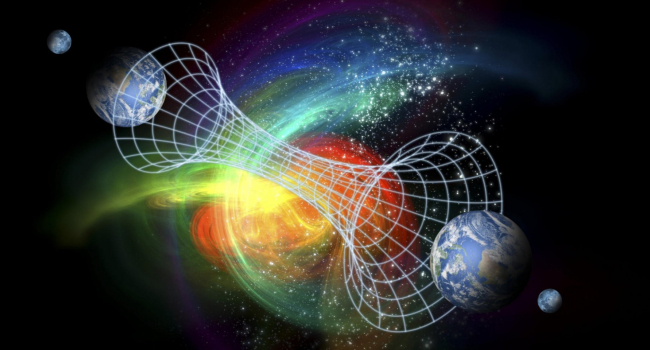
The question of whether parallel universes exist remains one of the most fascinating mysteries in modern physics. According to Dr. Alexey Semikhatov, Doctor of Physical and Mathematical Sciences, only artificial intelligence running on a full-scale quantum computer will be able to give a definitive answer. In an interview with Gazeta.Ru, the scientist explained why the combination of AI and a quantum computer may become the key to proving the many worlds interpretation of quantum mechanics.
How Parallel Worlds Are Born
According to the Everett–Deutsch (many worlds) interpretation, every quantum event creates a branching of reality. In one branch, you are reading this article; in another, you closed the tab at the headline; in a third, you did not turn on your computer today at all. An infinite number of such branches appear each second, and all of them truly exist but do not interact with one another.
The problem is that ordinary experiments cannot detect these other universes: as soon as we try to look beyond the limits of measurement, the wave function collapses and we remain in only one branch.
David Deutsch’s Idea: A Quantum Computer as an Interuniversal Traveler
British physicist David Deutsch, one of the pioneers of quantum computing, proposed a radical method of verification. In his view, a true quantum computer — error free and large scale — operates simultaneously in all parallel universes, using their computational resources. Qubits in a state of superposition literally exist in many worlds at once.
“If we launch sufficiently advanced artificial intelligence on such a computer and then receive a meaningful report from it about having experienced several universes simultaneously, this would be direct evidence,” explains Alexey Semikhatov.
Why AI and not a human Being? A human cannot be completely isolated from the surrounding environment; we are too strongly entangled with the world. But a digital consciousness running in an isolated quantum system can theoretically experience simultaneous existence in different branches and then return with memories of it.
“It is almost like a psychedelic experience without substances: AI has been in several universes at once and can tell us about it,” Semikhatov jokes.
When to Expect an Answer
Current quantum computers, even IBM and Google’s thousand qubit machines, are still too noisy and too small for such an experiment. What we need is a fault tolerant quantum computer with millions of logical qubits and full error correction. The most optimistic forecasts place this in the years 2035 to 2045.
Only then will it become possible to load AGI level artificial intelligence into it and ask the main question: “How many universes did you just experience?”
In Short
Theoretical physicist Alexey Semikhatov believes that only artificial intelligence running on a full scale fault tolerant quantum computer will be able to prove the existence of parallel universes. According to David Deutsch’s idea, such AI would experience multiple worlds simultaneously and then report this experience, providing direct evidence for the many worlds interpretation. The experiment may become feasible in ten to twenty years as quantum technologies scale up. Until then, the question remains open, but for the first time science has a concrete plan for how to answer it.