make preferable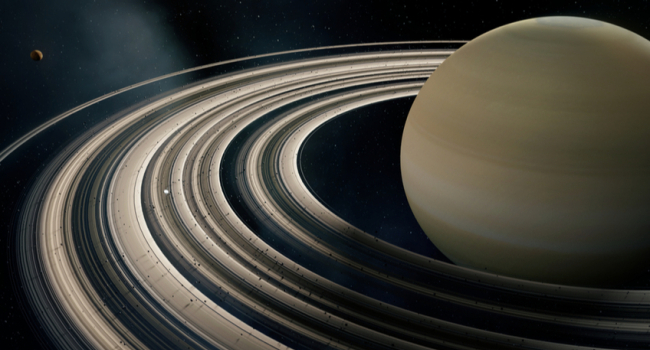
Saturn’s rings, despite their surprisingly “fresh” appearance, might be as ancient as the Solar System itself. This conclusion was reached by scientists from the Tokyo Institute of Technology and the French National Centre for Scientific Research. This discovery contradicts earlier assumptions that the rings formed relatively recently—just 100–400 million years ago. The findings were published in the journal Nature Geoscience.
Micrometeorites and the “Cleaning” Mechanism
Previously, scientists believed that over billions of years, micrometeorite collisions with Saturn's icy rings would have accumulated a significant amount of dust. However, a new theoretical model reveals that when micrometeorites collide with the rings at high speeds, the ice evaporates, and the contaminating particles are either ejected into space or drawn in by Saturn’s magnetic field. This “cleaning” mechanism allows the rings to maintain their youthful appearance over billions of years.
Possible Origins and Future of the Rings
Two leading hypotheses suggest that Saturn's rings either formed from remnants of a circumplanetary cloud of material that failed to coalesce into full-fledged moons or resulted from the destruction of a large moon after a collision with a meteorite or asteroid.
If the rings did indeed form at the dawn of the Solar System, this opens new avenues for exploring their origins. Researchers believe that chaotic collisions during that period could have created a debris cloud, which eventually coalesced into Saturn’s rings.
Another finding concerns the fate of the rings. Earlier estimates suggested they would disappear within 100 million years, but the discovery of the “cleaning” mechanism implies that their existence may last much longer.