make preferable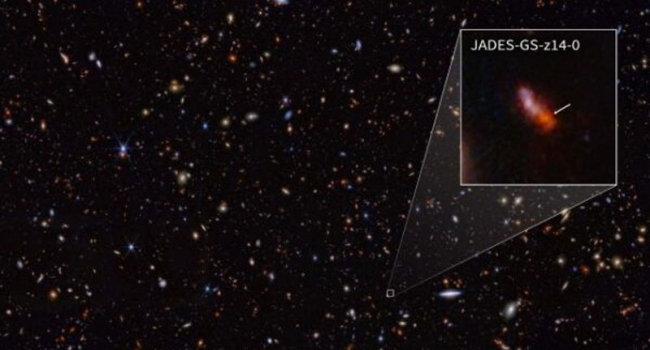
The James Webb Space Telescope has confirmed the existence of the most ancient galaxy in recorded history. The first of three papers published in the journal Nature presents compelling evidence for the discovery of the galaxy JADES-GS-z14-0, which existed less than 300 million years after the Big Bang. This fact surprises scientists, since such large, bright and developed galaxies simply should not have existed at that time.
According to astronomers Stefano Carniani from the Scuola Normale Superieur in Italy and Kevin Heinlein from the University of Arizona, in January 2024, the NIRSpec instrument observed this galaxy, JADES-GS-z14-0, for almost ten hours, and when the spectrum was first processed, it provided unambiguous evidence that the galaxy indeed had a redshift of 14.32, breaking the previous record for the most distant galaxy.
The NIRSpec near-infrared spectrograph on the James Webb Space Observatory can determine the redshift of an object by filtering out waves of the same range of natural origin - from chemical and physical processes in stars. Only after spectral analysis of an object, for example, a galaxy, can one draw a conclusion about its remoteness. After such an analysis, the galaxy JADES-GS-z14-0 was determined to be the oldest (or youngest, depending on the starting point) in the history of observations.
The extent of the galaxy JADES-GS-z14-0 is estimated at least 1600 light years. This indicates that the light comes mainly from young stars, and not from a massive black hole at its center. The mass of the galaxy exceeds several hundred million solar masses, which is about 10% of the mass of our Milky Way galaxy. Although it seems small, this galaxy was unusually advanced for its time, when such galaxies should not have existed.
James Webb gave us a glimpse into a time when the Universe was shrouded in a fog of atomic hydrogen that scattered visible light and prevented scientists from peering into the depths of time. What we saw there defied science on Earth. The dynamics of the evolution of stars and galaxies exceeded all theoretical calculations. The galaxy JADES-GS-z14-0 contains so much dust and heavy elements (in astronomy, this is everything heavier than helium) that it cannot be explained by current theories. For this to happen, many generations of heavy stars would have to live and die, which is simply incredible for a time 300 million years after the Big Bang.