make preferable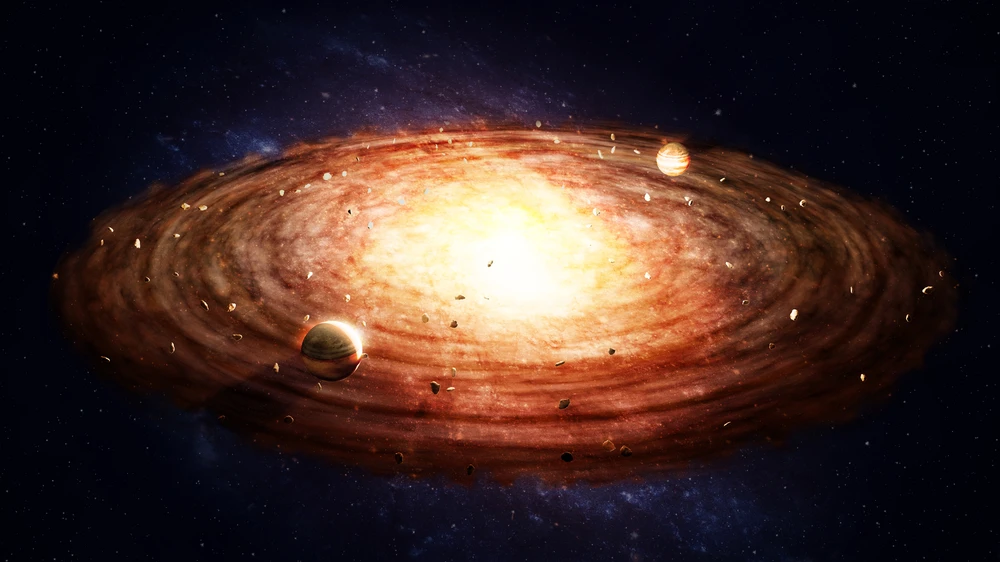
Giant planets must manage to form their enormous gaseous envelopes before the young star runs out of building material. New observations from the James Webb Space Telescope show how this gas is gradually carried off into space — first by powerful magnetic jets and molecular winds, and later by flows driven by the star’s radiation, reports Sciencedaily.com.
The study, led by Naman Bajaj of the University of Arizona, covered 72 young Sun-like stars and their protoplanetary disks. It is one of the largest studies of planet formation conducted with JWST. The results were published in The Astronomical Journal.
Planets have limited time to grow
Planets form inside disks of gas and dust surrounding young stars. It is from this material that future planets gradually come together, but the gaseous component of the disk does not last long on cosmic timescales.
When the Sun was young, it too was surrounded by a dense protoplanetary disk. During the first few million years, it contained about 100 times more gas than dust. Over time, nearly all of this gas disappeared.
This is especially important for future gas giants. Jupiter and Saturn needed to accumulate enormous atmospheres from the surrounding disk. If the gas disperses too quickly, a forming planet may simply not have enough time to gather sufficient material.
That is why the disappearance of the protoplanetary disk effectively starts a timer: once the gas is gone, the chance to form a gas-rich planet drops sharply.
Webb saw molecular gas being carried away from the disk for the first time
To trace this process, the researchers used archival mid-infrared JWST observations obtained with the MIRI instrument. The 72 systems are at different stages of development, so together they provide a kind of sequence of frames that makes it possible to reconstruct how the disk-dispersal process changes with age.
The scientists looked for two main signs of escaping gas — molecular hydrogen and ionized neon.
Before JWST, astronomers could not directly observe molecular hydrogen in this way. Previous studies had suggested that in the earliest stages of a system’s development, sufficiently dense molecular winds should exist around the star, capable of even blocking X-ray radiation.
The new observations confirmed this picture.
In the youngest systems, where material is still actively falling onto the central star, astronomers found powerful jets and broad winds containing molecular and atomic gas. They are likely linked to magnetic fields permeating the protoplanetary disk: the gas moves outward along magnetic field lines, carrying away both matter and angular momentum at the same time.
As the system ages, the star begins blowing gas out of the disk
Then the picture changes.
As the system evolves, the flow of material onto the star weakens, and with it the magnetic jets become weaker as well. The escaping gas gradually becomes predominantly atomic.
At this point, the radiation of the young star begins to play an increasingly important role. Ultraviolet and X-ray rays penetrate the thinning disk and heat the gas enough for it to escape the system. This process is called photoevaporation.
The study shows that protoplanetary disks do not disappear in just one way. In the early stages, their gas is actively carried away by magnetic jets and molecular winds. Later, as the disk becomes thinner, atomic winds — including those driven by the star’s radiation — become increasingly important.
Thus, the disk-dispersal process changes along with the age of the planetary system.
JWST detected several types of winds at once
Of the 72 disks studied, extended emission of molecular hydrogen and ionized neon was found in 66 systems.
Conical molecular winds were found in 46 systems, and fast jets traced by neon emission were found in 40. At the same time, every system with a neon jet also showed signs of a wind traced by molecular hydrogen or oxygen.
For astronomers, this is important not only as confirmation of the existence of individual flows of matter. The observations make it possible to link different mechanisms of gas loss to specific stages in the development of a planetary system.
“Planet formation is therefore a race against time,” Bajaj says. Gas giants like Jupiter must manage to assemble their massive atmospheres while the disk is still dense enough to supply them with the necessary raw material.
From one disk to dozens of young systems
The new study continues the work of the same research group. In 2024, Bajaj, Gorti, and their colleagues used JWST to observe gas leaving the protoplanetary disk around the young star T Cha.
At that time, the telescope made it possible to examine the process in detail in one specific system. Now, observations of 72 young stars have shown what happens to disks at different stages of their development and how the balance between magnetic jets, molecular winds, and atomic winds changes over time.
The next question for the researchers is exactly how much gas these processes can remove from the disk and in which regions of it the loss of material begins. The answer will make it possible to determine more precisely how quickly the window for planet formation closes and why some systems manage to produce gas giants, while in others the gas is mainly sufficient for the formation of less massive worlds.