make preferable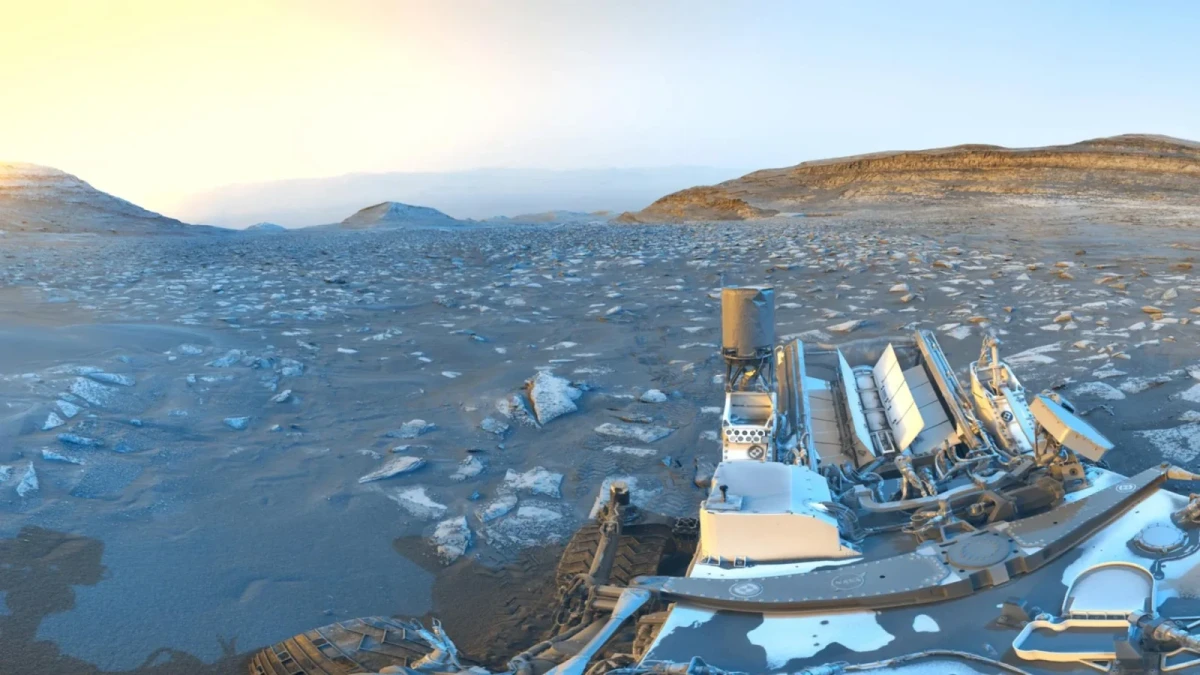
NASA’s Curiosity rover has now spent 5,000 Martian days on Mars and marked the milestone with an unusual panorama. The spacecraft captured the surrounding landscape in the morning and in the afternoon, and specialists then combined the two images into a single “postcard” view of Mars, adding representative colors for the different times of day.
Curiosity’s milestone 5,000th sol fell on August 30, 2026. That day, at 9:56 local Martian time, the rover took the first panorama while positioned near a sandy ridge unofficially named Chocolatal. The second image was taken on September 2, on the 5,003rd sol, at 17:39.
One Mars — morning and evening at once
For the shoot, Curiosity used its navigation cameras. They usually take black-and-white photographs, but this time the two images were processed in a special way.
The morning panorama was marked in blue, and the daytime one in yellow. The images were then merged to create a single landscape in which the different shades show how the lighting of the Martian terrain changes over the course of the day.
Curiosity has created similar “postcards” before. The new image continues that tradition while also showing how dramatically the appearance of the same area changes depending on the Sun’s position.
Curiosity itself is visible in the frame
In the foreground of the panorama, parts of the rover itself can be seen. In particular, the cylindrical UHF antenna is visible in the frame; Curiosity uses it to transmit data to spacecraft orbiting Mars.
Behind the vehicle, its finned MMRTG radioisotope thermoelectric generator can be seen. It serves as Curiosity’s main power source and allows the rover to operate on the Martian surface for many years.
The rover’s wheel tracks are also clearly visible on the surface, stretching into the distance across the Martian soil.
View of Gale Crater and Mount Sharp
Curiosity is currently exploring the lower slopes of Mount Sharp — a mountain massif about 5 kilometers high rising from the center of Gale Crater.
The rover is positioned on a slope and looking downward toward the crater floor. On the distant horizon, the rim of the crater itself can be made out, although because of the enormous distance it appears only as a thin line.
Curiosity has been operating on Mars since 2012. During that time, the rover has traveled dozens of kilometers across the planet’s surface and continues to study the geology of Mount Sharp, trying to reconstruct the history of Mars’s ancient environment.
Now another milestone has been added to its long history — 5,000 Martian days on the Red Planet.