make preferable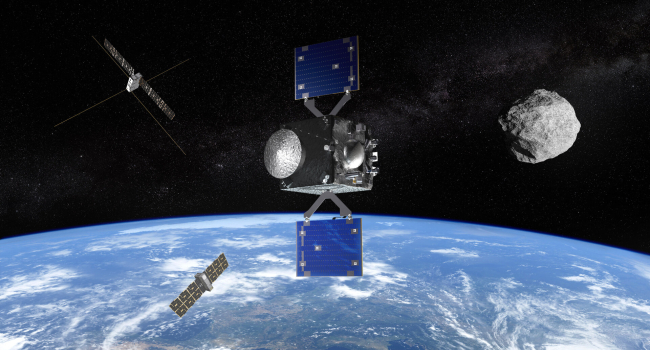
The European Space Agency (ESA) has unveiled a new planetary defense mission named Ramses, which will fly to the near-Earth asteroid 99942 Apophis. The satellite will join the asteroid in 2029 when it approaches our planet at a very close distance — even closer than the region where geosynchronous satellites are located.
Ramses stands for Rapid Apophis Mission for Space Safety. This is the next step in humanity's efforts to study near-Earth asteroids and ways to deflect them in case one of them ever finds itself on a collision course with planet Earth.
To meet Apophis in February 2029, ESA scientists have been given permission to start planning Ramses even before the space agency officially approves the mission. The decision on the mission, as well as funding allocation, is expected to be made at the ESA Council of Ministers meeting in November 2025. The launch is scheduled for April 2028.
Ramses is expected to accompany the asteroid during its flyby of Earth in April 2029. Scientists will be able to study the asteroid as Earth's gravity alters its physical characteristics. As noted by the agency, the results obtained will improve "our ability to protect our planet" from any similar object in case of a collision threat.
The design of Ramses is planned to be similar to the ESA's Hera mission, which will be launched in 2024 to the double asteroid system Didymos. Ramses will also carry two CubeSat passengers, which will separate from the main spacecraft once it approaches the asteroid.
Apophis has a diameter of about 375 meters. On April 13, 2029, it will pass at a distance of 31,860 kilometers from Earth. For comparison, the geosynchronous orbit is at an altitude of 35,786 km above the Earth's surface. Such close flybys of asteroids hundreds of meters in diameter occur on average only once every 5,000–10,000 years.
When Apophis was discovered in 2004, it temporarily became the most dangerous known asteroid. According to preliminary expert assessments, the risk of its collision with Earth existed in 2029, 2036, or 2068. Later, the risk of collision with Apophis was ruled out for the next hundred years.