




 make preferable
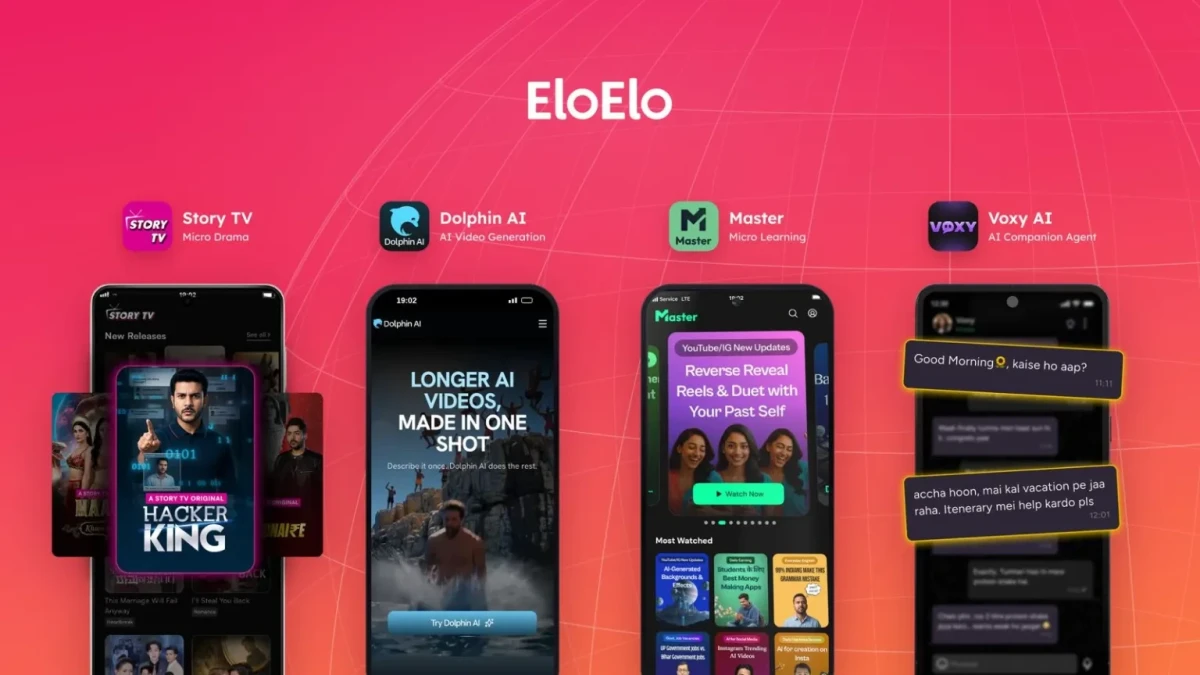
Indian company EloElo has raised $80 million in a Series C round led by Hornbill Capital and NBCUniversal. The investment will help it develop Story TV, one of India’s largest microdrama streaming apps. The deal values the company at $500 million and brings its total funding to $130 million.
Investor interest is being driven by the rapid growth of short-form series designed for smartphone viewing. According to analysts, more than 118 million people in India watch microdramas each month, while Story TV has more than 33 million active users, TechCrunch reports.
Microdramas are becoming mainstream mobile entertainment
Microdramas are short serialized stories typically watched on a smartphone’s vertical screen. Unlike traditional series designed for extended viewing, these productions are divided into brief episodes that are easy to watch throughout the day, during breaks or while commuting.
The format is gaining popularity not only in India but also in the United States and China. Hollywood figures are already entering the space: celebrities investing in microdrama projects or appearing in them as actors include Issa Rae, James Franco, and Kim Kardashian.
India is particularly attractive for this business thanks to its vast internet audience and strong demand for entertainment content. Analysts estimate that annual revenue from the country’s microdrama industry could exceed $3–4 billion by 2030.
Dedicated apps already hold a prominent position in the market. Story TV, Kuku TV, and Quick TV ranked among the country’s most downloaded video streaming services in 2025.
Story TV bets on short episodes and original stories
EloElo was founded in 2020 by Saurabh Pandey, who previously worked at Flipkart. In recent years, Story TV has grown into a platform with a library of more than 5,000 titles in six languages.
According to Pandey, users spend an average of 95 minutes a day in the app, spread across several viewing sessions. He believes the next generation of internet users will see the smartphone as their primary entertainment screen, and serialized content needs to reflect that behavior.
Traditional television assumes that viewers set aside a specific time to watch a program. Mobile microdramas, by contrast, are designed for numerous short windows throughout the day. At the same time, EloElo’s founder believes that while short videos have already learned to meet the demand for quick content, sequential, serialized storytelling for this kind of viewing has remained underdeveloped.
Pandey does not believe big screens will disappear: watching films and shows with family or friends will remain popular. However, he predicts that the bulk of entertainment consumption will gradually shift to mobile devices.
Story TV competes not only with other microdrama apps but also with YouTube, Instagram, and TikTok, where users can watch videos and creators’ serialized content for free. EloElo is therefore focusing on production quality and its own library of stories.
One way it is expanding its catalog is through a partnership with Indian television company Balaji Telefilms, which helps produce content for the platform.
Millions of viewers do not yet translate into sustainable revenue
Despite audience growth, monetization remains one of the market’s main challenges. Story TV offers monthly, quarterly, and annual subscriptions that unlock paid content. Some content is available for free with ads, but industry research suggests the advertising model may generate less revenue than subscriptions.
The problem is that many users are willing to watch microdramas but are in no hurry to pay for them. According to a Redseer study, more than 40 million people in India have paid for access to microdramas at least once, but only 15–17 million users regularly pay for such content each month. A separate Ormax Media survey found that 72% of viewers had never paid to watch microdramas.
A large audience alone therefore does not guarantee that platforms will be profitable. Companies need to persuade viewers accustomed to free videos on social media to subscribe for access to series.
For Story TV, this means further growth depends not only on attracting new users but also on its ability to consistently release content that audiences are genuinely willing to pay for.
EloElo wants to use AI to produce content
Artificial intelligence tools are another area of development for the company. Competitors are also experimenting with production automation: Google-backed Kuku, for example, is developing AI tools to speed up workflows and create new content, while Dashverse, with its Shortfree platform, is betting on generative video models to produce serialized videos.
EloElo is developing its own platform, Dolphin AI. Initially built as an internal tool to improve the video production process, it is now set to become available to a wider audience.
According to the project’s website, Dolphin AI can function as an editor with ready-made templates and a selection of models for generating images, audio, and video. In the future, EloElo hopes to use the platform not only to produce entertainment content but also for marketing campaigns and advertising.
However, Pandey does not believe AI can replace a creative team on its own. He compares the technology to a race car: artificial intelligence provides power and speed, but an experienced professional—a creative director or showrunner—must be behind the wheel. It is the human who sets the direction, manages the tools, and takes responsibility for the quality of the story.
In the EloElo founder’s view, the best results so far come from combining human creativity with AI capabilities, rather than fully automated production.
Funding will go toward new projects and expanding the AI team
In addition to Story TV, EloElo is developing two other apps. Master offers educational videos in a vertical format and competes with Seekho and Kuku’s Guru. Voxy AI is an AI companion app.
The company says the combined monthly audience across all its apps exceeds 40 million users. It does not disclose the audience breakdown by service, noting only that Story TV accounts for the majority of users.
EloElo currently employs around 240 people. The company intends to expand its artificial intelligence and machine learning research team, while also allocating a significant portion of the funding to producing new original projects.
Alongside Hornbill Capital and NBCUniversal, participants in the Series C round included MIT Investment Co. and several existing investors, including Play Ventures, Kalaari Capital, Waterbridge Ventures, and Griffin Gaming Partners.
The $80 million deal shows that investors see microdramas not merely as a type of short video, but as a distinct segment of the mobile entertainment industry. However, Story TV’s future success will depend on whether the company can turn widespread interest in short-form series into a stable paying audience—and use AI to scale up production without compromising storytelling quality.