make preferable
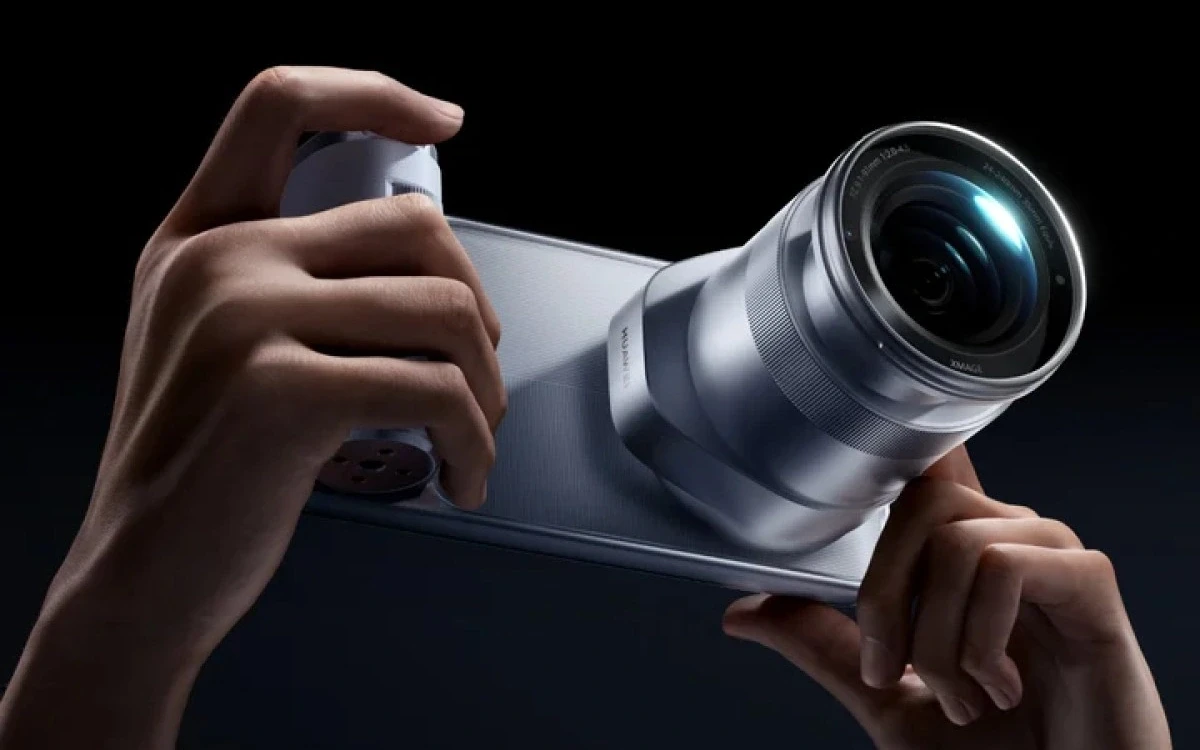
Smartphones have learned to take high-quality photos in almost any conditions, but manufacturers continue to look for ways to bring mobile photography closer to professional standards. One of the most unusual options is the Ruiying Z10 modular optics system for the HUAWEI Mate 90 Pro Max, which allows an external lens to be connected to the smartphone. The solution looks impressive, but it raises a logical question: is it worth paying for such a kit when, for comparable money, you could buy a separate mirrorless camera?
The HUAWEI Mate 90 Pro Max Is Good Even Without External Optics
Even without additional accessories, the Mate 90 Pro Max looks like a full-fledged flagship. The smartphone features a 6.9-inch OLED display with a 120 Hz refresh rate and a claimed peak brightness of up to 12,000 nits, third-generation Kunlun Glass protection, and a Kirin 9050 Pro processor. Its 6,800 mAh battery supports 100 W wired charging and 50 W wireless charging.
The main camera also comes with a serious set of specs: a 50 MP primary sensor with a variable aperture, a 40 MP ultra-wide module, and a 200 MP periscope camera with a 1/1.28-inch sensor.
The body is protected against water and dust to IP68/IP69 standards, and basalt fiber is used in its construction.
For most everyday scenarios, this hardware is more than enough. That is why the external lens is primarily of interest to those who want to get more photographic capabilities out of their smartphone.
How Much the Switch to Interchangeable Optics Costs
The main drawback of the system is the price. According to the estimates cited in the article, the base version of the Mate 90 Pro Max with 12 GB of RAM and 512 GB of internal storage costs about 9,499 yuan. The full Pro Camera Kit with the Ruiying Z10 modular system and grip is priced at 19,499 yuan.
In other words, the cost of the kit is roughly twice the price of the smartphone itself. At the same time, the buyer is not paying for a universal photography system, but for a specialized accessory whose compatibility with future devices will depend on the manufacturer’s decisions.
For a comparable amount, you could consider a separate mirrorless camera—for example, the Sony A6700, Fujifilm X-S20, or Canon EOS R10 with a suitable lens. Such cameras offer larger sensors, full interchangeable-lens systems, and more familiar ergonomics for serious shooting.
A dedicated camera also has an advantage in terms of service life: lenses can usually be used across several generations of compatible cameras. The upgrade prospects of a specialized smartphone module are less obvious.
Who Really Needs an External Lens
The system has a clear target audience. These are mobile photographers, bloggers, and journalists for whom it is important to capture high-quality shots and immediately send them to the newsroom or publish them online.
A smartphone combines a camera, image processing, connectivity, and publishing apps. External optics could potentially preserve these advantages while adding capabilities unavailable to built-in modules.
But this comes at the expense of compactness. A smartphone with a mounted lens becomes a bulky device that is no longer as convenient to carry in a pocket. Additional questions arise: how to store the accessory, how to protect the connection from dust, and what will happen to the expensive setup if it is dropped.
Moreover, before evaluating the system as an alternative to a camera, it is necessary to compare real-world photos, optical quality, ease of control, and autofocus performance. Technical specifications alone are not enough to prove the superiority of an external module over built-in cameras or a separate mirrorless camera.
Why This Is Not Yet a Mainstream Solution
Mobile photography became popular largely because of its simplicity: take out your phone, press a button, and get a finished shot. External optics change that scenario by adding a separate accessory and extra steps.
There is also the question of long-term compatibility. If future smartphones get a different body design or connection interface, the expensive module could turn out to be incompatible with the new device. However, without confirmed information about the manufacturer’s plans, it cannot be claimed that this will necessarily happen.
That is why, for now, interchangeable optics for a smartphone are more reasonably viewed as a niche tool for enthusiasts rather than a necessary upgrade for a mobile camera.
Is the HUAWEI Mate 90 Pro Max With a Lens Worth Buying?
If the main goal is to get a versatile smartphone with a powerful camera, the built-in modules of the Mate 90 Pro Max should be enough for most users. Paying extra for an external lens only makes sense if its specific optical capabilities are truly necessary for your work or hobby.
If photography plays an important role in your life and you are willing to carry separate gear, a mirrorless camera may turn out to be the more practical long-term purchase. It offers its own interchangeable-lens system, and you will not necessarily have to replace the lenses along with your next smartphone.
Bottom line: HUAWEI’s idea is interesting as an engineering experiment, but an unusual design alone does not make the kit a worthwhile purchase. For interchangeable optics to become a mainstream solution, it will have to prove that the image quality and shooting convenience justify the extra cost, weight, and complexity.