make preferable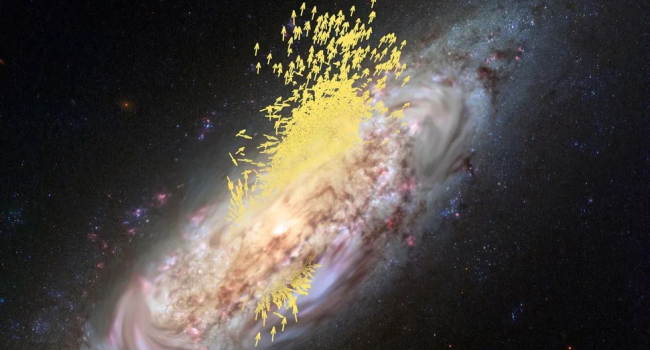
New computer models show that our galaxy's disk may have once "flipped" by nearly 90 degrees. This event, together with an ancient collision with another galaxy, explains the unusually slow rotation of the Milky Way's stellar halo.
What scientists discovered
Kirill Batrakov from Durham University and his colleagues traced the evolution of 25 Milky Way-like galaxies over billions of years. They found that galaxies with slowly rotating halos almost always experienced head-on collisions with other systems and at some point "flipped" their disks.
Batrakov noted that astronomers already know the Milky Way underwent a powerful head-on collision with the Gaia-Sausage-Enceladus galaxy, so the team believes the Milky Way's disk most likely also flipped in the past.
The collision and the flip
Gaia-Sausage-Enceladus — a dwarf galaxy with a mass of over 10 billion solar masses — crashed into the Milky Way 8–11 billion years ago. Its stars were torn apart and placed on elongated "sausage-shaped" orbits, which now form part of the halo. These stars rotate more slowly relative to the disk.
The disk flip further enhances the effect. When the disk changes orientation, the halo does not immediately adjust to the new position. As a result, a misalignment occurs, and the halo stars appear to rotate slowly relative to the current disk.
What this means for the Solar System
If the flip occurred during the existence of the Solar System, it could have altered its orbit around the galactic center.
Batrakov explained that a disk flip means most of the Milky Way's stars, possibly including the Sun, once moved along completely different trajectories, adding that the "stable" position in the galaxy may not have been so stable throughout the Solar System's history.
Why this matters
Much of our knowledge about other galaxies is built on studying the Milky Way. Understanding that its disk may have flipped adds an important chapter to our galaxy's history and helps more accurately compare it with other spiral systems.
The study was presented at the Royal Astronomical Society's National Astronomy Meeting in Birmingham.
In brief
Computer models have shown that the Milky Way's disk likely flipped by 90 degrees in the past. This event, along with the collision with the Gaia-Sausage-Enceladus galaxy 8–11 billion years ago, explains the slow rotation of the stellar halo. The flip could also have affected the Solar System's orbit. The work helps to better understand our galaxy's history and its place among other spiral systems.