make preferable
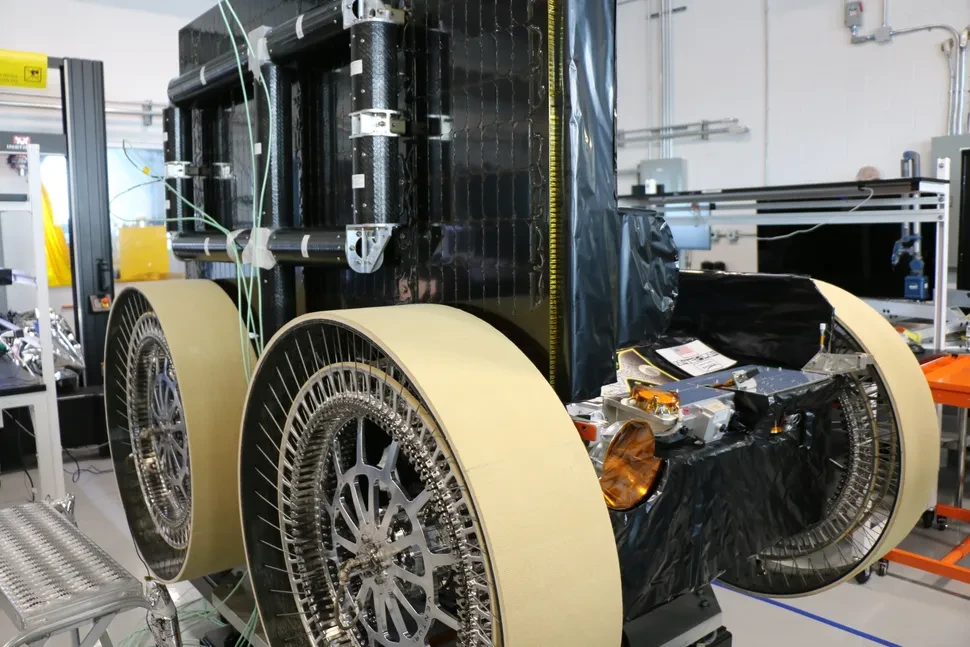
At the end of 2026, the American company Astrolab plans to send the unmanned FLIP rover to the Moon’s south pole with the Spaceborne Computer-4 computing module from Hewlett Packard Enterprise (HPE). This will be the first attempt to test high-performance computing and artificial intelligence on the lunar surface. These technologies could help future lunar expeditions navigate terrain, analyze the environment, and operate autonomously.
The rover will fly as part of the Griffin-1 mission, which Astrobotic is carrying out for NASA. The experiment is intended not only to verify that the computing system can function in extreme conditions, but also to show what tasks modern computers will be able to handle directly on the Moon without constant support from Earth.
The computer must survive the lunar night
Spaceborne Computer-4 was developed specifically for operation in space. It features compact dimensions, low weight, a self-contained design, and no fan. At its core are an energy-efficient 64-bit central processor and a graphics processor that will make it possible to perform computational tasks, including those related to AI.
The module will be connected to the rover’s cooling system, while power will be supplied by FLIP’s batteries and solar panels. KIOXIA solid-state drives are provided for data storage.
The main challenge is the conditions at the Moon’s south pole. According to Astrolab founder and CEO Jaret Matthews, NASA requires the vehicle to be designed for a full year of operation on the surface. During that time, it will have to survive several lunar nights, during which there will be no sunlight for up to 150 consecutive hours and, therefore, no energy input from the solar panels.
In such conditions, the equipment must withstand extreme temperatures and long periods without solar heating. The computer is made using thermally conductive aluminum and was designed with the specifics of the lunar environment in mind. However, the upcoming mission must confirm that the system is capable of operating in real conditions, not just surviving laboratory tests.
The rover is also designed for long-term semi-autonomous operation when no astronauts are nearby. According to the developers’ concept, such a platform will be able to spend many months on the Moon and travel hundreds of kilometers.
AI will help study the surface and avoid hazards
The computing module will process visual data collected during the mission, as well as support navigation, mapping, and terrain analysis. A separate part of the experiment is dedicated to running AI directly on the Moon.
HPE says it plans to demonstrate the possibility of reliably deploying scalable AI services on the lunar surface. At the same time, the specific applications that will be used in the experiment have not yet been disclosed.
One of the most interesting tests is related to navigation technology developed by NASA’s Jet Propulsion Laboratory (JPL). The corresponding software was previously used on Mars, and it will be tested on the Moon for the first time.
There is no GPS on either Mars or the Moon, so it is difficult for spacecraft to determine their position using familiar satellite systems. The machine-learning algorithm developed at JPL solves this task differently: it compares a pre-saved map with images of the surrounding terrain, identifies matching surface features, and helps determine the vehicle’s location.
Such a system could be especially useful when traveling through unfamiliar territory, where hazardous areas must be recognized and craters avoided. If the tests are successful, technologies like this could increase the independence of future lunar rovers and reduce the need for constant control from Earth.
Why astronauts need computing power on the Moon
It is still too early to say exactly how these technologies will be used in crewed expeditions. On the International Space Station, computers are already used for communication, scientific experiments, and the crew’s everyday tasks. But the capabilities of autonomous computing and AI on the lunar surface still have to be tested.
Local data processing could potentially allow spacecraft to respond more quickly to changes in the environment and perform some tasks without waiting for commands from Earth. This is important for missions in which communications are limited and equipment must operate for long periods without human intervention.
At the same time, the upcoming experiment does not guarantee that all these capabilities will immediately appear in future crewed programs. Its main goal is to test the reliability of the equipment and demonstrate the operation of AI services in conditions for which ordinary Earth-based computing systems are not designed.
What else will be delivered to the Moon
Griffin-1 will be the first mission of the Griffin lunar lander created by Astrobotic. The Pittsburgh-based company is carrying out the flight under NASA’s Commercial Lunar Payload Services (CLPS) program, which involves delivering scientific and technological payloads to the Moon with the help of commercial contractors.
In addition to the FLIP rover, the payload will include Astrobotic’s small unmanned CubeRover vehicle, the LandCam-X optical navigation system, and the miniature Nanofiche GLPH archive — Galactic Library to Preserve Humanity — intended to preserve materials about the history of humankind.
Thus, Griffin-1 will become not only a demonstration of new means of mobility on the Moon, but also a testing ground for technologies that may be needed to build long-term infrastructure beyond Earth. If HPE’s computer withstands lunar conditions and successfully completes its planned tasks, this will be an important step toward using more autonomous computing systems in future exploration of the Moon and other celestial bodies.