make preferable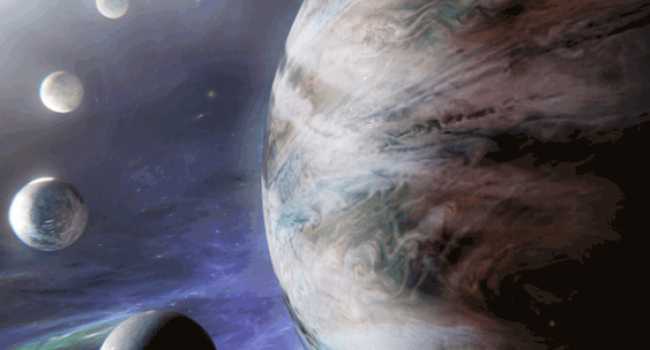
The James Webb Space Telescope has recorded a mysterious chemical signal on two of the most interesting icy worlds in the Solar System — Titan and Pluto. Scientists have not yet been able to identify the molecule responsible for it.
What Webb showed
An international team of astronomers led by Bruno Bézard of the French National Centre for Scientific Research analyzed infrared observation data. The new signal appeared independently on two different instruments of the telescope — the possibility of hardware error has been ruled out.
Titan and Pluto are separated by billions of kilometers, have different temperatures, pressures, and geological activity. However, both celestial bodies are rich in nitrogen and hydrocarbons. It is precisely this chemical similarity, according to the researchers, that may explain the appearance of the same spectral "fingerprint."
What it could be
The scientists compared the unknown signal with extensive databases of molecular spectra. The closest matches were benzene, propadiene, ketene, and acetylene, but none of these substances provided a complete match.
It is possible that this is a familiar molecule behaving unusually — for example, in a complex chemical mixture or in a special physical state (frozen, in aerosol form, etc.). Interestingly, the signal on Pluto is significantly stronger than on Titan.
What's next
Unraveling the nature of the mysterious compound will be helped by the future NASA Dragonfly mission — a rotorcraft probe planned to be sent to Titan in the 2030s. Its mass spectrometer will be able to directly analyze the composition of the surface and atmosphere of Saturn's moon.
In brief
The James Webb Space Telescope has detected the same unknown chemical signal in the infrared range on Titan and Pluto. No known molecule matches it completely. Both worlds are rich in nitrogen and hydrocarbons, which is likely what leads to the appearance of this signature. The signal is stronger on Pluto. Unraveling the mystery will be aided by NASA's Dragonfly mission, planned for the 2030s. The work was published in the journal Astronomy & Astrophysics.