make preferable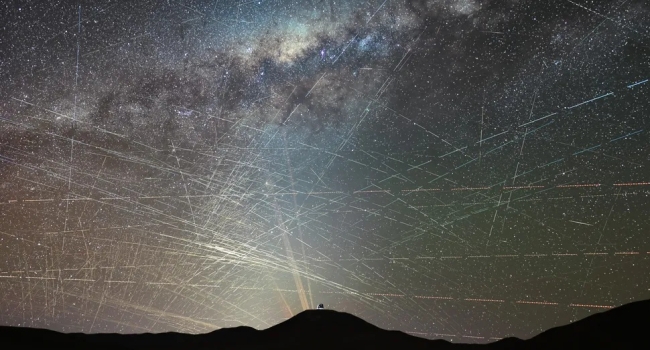
If the number of satellites in low Earth orbit exceeds 100,000, astronomy from Earth's surface could become practically impossible. This alarming conclusion was reached by scientists at the European Southern Observatory (ESO) in a new study, reports Space.com.
When telescopes will lose their meaning
Olivier Hainaut, ESO's Director of Operations and lead author of the study, stated that conditions could be reached where operating telescopes no longer makes sense because all data would be ruined — all of it, 100 percent.
The scientists conducted simulations to assess the impact of different numbers of satellites and their brightness on astronomical observations. The conclusions are discouraging: if satellites are relatively dim, astronomy may still adapt. But if their brightness exceeds a certain threshold (around 7th magnitude), research will become significantly more expensive and less effective.
Satellites affect the sky in two ways: they increase the overall brightness of the night sky (light pollution) and leave bright streaks in telescope images.
Plans that threaten science
Particular concern is raised by the American company Reflect Orbital's project, which plans to launch tens of thousands of giant mirrors to reflect sunlight onto Earth. These mirrors will be brighter than the full Moon in the illuminated zone, and brighter than Venus outside it. If the company realizes its plans (50,000 satellites), hundreds or even thousands of extremely bright objects will be visible in the sky from any point on Earth at any given time.
Hainaut emphasized that what they are proposing would make observations practically impossible, calling them super-bright satellites.
Equally dangerous are SpaceX's plans to launch a million orbital data centers with huge solar panels. Although individual satellites will be relatively dim, their sheer number will significantly worsen the situation.
No escape even in the darkest desert
One of the main problems is that it is impossible to "run away" from satellites. Even in the most remote locations on the planet — the Chilean Atacama Desert, the Australian outback, or Antarctica — the sky will be littered with artificial objects.
Robert Massey of the Royal Astronomical Society noted that the public did not sign up for a completely transformed sky.
What experts say
The International Astronomical Union considers an increase in light pollution of more than 10% above natural dark sky levels to be a "killer of astronomy." Under Reflect Orbital's plans, night sky brightness could increase by 300%.
There are currently about 14,000 satellites in Earth's orbit. If the trend continues, astronomy from the planet's surface could become impossible within the coming decades.
In brief
The growing number of satellites in orbit threatens to make ground-based astronomy impossible. According to ESO calculations, if their number exceeds 100,000 — let alone with the implementation of Reflect Orbital's (50,000 mirrors) and SpaceX's (one million data centers) projects — telescope data would be severely compromised. Increased light pollution and satellite trails would make observations significantly more expensive or meaningless. Scientists warn that without strict regulation, humanity risks losing the ability to study the Universe from Earth's surface.