make preferable
Gravity feels like something so commonplace that we practically fail to notice its existence. Yet, it is precisely what holds people, buildings, oceans, and even the atmosphere onto the surface of the Earth. Therefore, the question of what would transpire if gravity were to vanish for even a single second has long intrigued not only science fiction enthusiasts but also physicists.
It is worth noting immediately: such a scenario is impossible. According to NASA, you cannot simply "turn off" gravity—it is dictated by the mass of the planet. For Earth to stop attracting objects, it would have to instantly shed almost all of its mass. But if we imagine such a situation as a thought experiment, the consequences would be catastrophic, writes The Day.
The first second: everything begins to "fly away"
As long as gravity is active, it anchors all objects to the surface of the planet. If the attraction disappears, people, cars, animals, the water in lakes and rivers, as well as any unfastened items will continue to move by inertia and literally detach from the Earth.
The reason is that the planet rotates around its axis at a speed of up to 465 meters per second at the equator. Without the force of gravity, all objects will move along a tangent line, much like a stone slipping from a spinning sling. In just one second, people and objects will manage to rise about five meters.
The return of gravity
The most hazardous events will commence the exact moment gravity "switches" back on. Everything that managed to rise will begin to fall back down with the acceleration of free fall. For a human being, such an impact would be comparable to falling from a height of several stories. Widespread destruction will hit buildings, bridges, and other engineering structures that were never engineered to withstand such unusual stress loads.
The atmosphere and oceans will also be set in motion
The consequences will affect more than just people. During the absence of gravity, the upper layers of the atmosphere will begin to expand and shift toward outer space. Once the gravitational pull returns, the air will rush back down, which could trigger a massive shockwave and sharp fluctuations in atmospheric pressure.
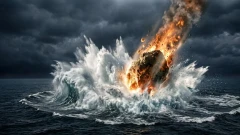
An equally dramatic scene awaits the oceans. Immense masses of water will briefly lose their connection to the Earth's surface, only to crash back down with colossal force. According to scientists' estimates, this could give rise to waves comparable in scale to the largest tsunamis. Gravity influences not only the planet's surface but also the distribution of stress loads within the Earth's crust. Its sudden disappearance would disrupt the established equilibrium, which theoretically could provoke large-scale seismic activity across many regions of the world simultaneously.