make preferable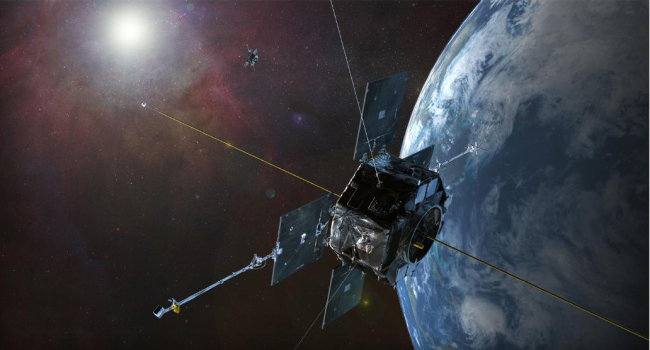
A major scientific satellite built by NASA — Van Allen Probe A — is expected to reenter Earth’s atmosphere on March 10, 2026.
The spacecraft weighs about 600 kg (1,323 lb) and spent nearly 14 years in space studying the environment around our planet. Most of the satellite will burn up during atmospheric reentry, and the risk to people on Earth is considered extremely low.
The mission of the Van Allen Probes
Two identical spacecraft — Van Allen Probe A and Van Allen Probe B — were launched on August 30, 2012 as part of NASA’s Living With a Star program.
Their goal was to study the Van Allen radiation belts, two rings of high-energy charged particles trapped by Earth’s magnetic field.
These belts can be dangerous because intense radiation from solar storms can affect:
- satellites in orbit
- astronauts
- communication and navigation systems
- electrical infrastructure on Earth
The probes were named after James Van Allen, who discovered the radiation belts in 1958.
The mission was originally planned to last two years, but both spacecraft significantly exceeded expectations:
- Probe B operated until July 2019
- Probe A continued until October 2019
Even today, scientists are still analyzing the enormous dataset gathered during the mission to improve space weather forecasting.
Why the satellite is falling earlier than expected
After the spacecraft ran out of fuel, they were placed in an inactive orbit. Originally, researchers expected them to remain there until about 2034.
However, increased activity on the Sun in recent years caused an unexpected change.
Higher solar activity heats Earth’s upper atmosphere, causing it to expand slightly. This increases atmospheric drag on satellites in low Earth orbit.
As a result, the orbit of Van Allen Probe A gradually decayed faster than predicted, leading to its uncontrolled descent.
Its twin spacecraft, Probe B, was less affected and is expected to remain in orbit until around 2030 or later.
When and how the reentry will occur
According to tracking data from the United States Space Force, the spacecraft was expected to reenter around:
- March 10, 2026 — approximately 19:45 EDT (±24 hours)
- March 11 — 03:45 Moscow time
- March 11 — 04:45 Yerevan time
Because atmospheric reentries are difficult to predict precisely, the time window can shift as new tracking data arrives.
During reentry:
- most components will burn up in the atmosphere
- some stronger parts (such as titanium components) may survive and reach the ground
Risk to people on Earth
NASA estimates the chance of debris causing harm at roughly 1 in 4,200 (≈0.024%), which is considered extremely small.
The main reasons:
- about 70% of Earth’s surface is covered by oceans
- large areas are sparsely populated
- surviving debris pieces are typically scattered over wide regions
Therefore, the most likely outcome is that any remaining fragments will land in the open ocean.
The legacy of the mission
The Van Allen Probes dramatically improved our understanding of the dynamic radiation environment surrounding Earth.
Their data helped scientists:
- refine models of space weather
- better protect satellites and astronauts
- prepare for future deep-space missions
NASA and the U.S. Space Force continue to monitor the spacecraft’s descent and will update predictions via space-tracking systems.
In brief
The 600-kg satellite Van Allen Probe A, launched by NASA in 2012 to study the Van Allen radiation belts, is expected to reenter Earth’s atmosphere on March 10, 2026. Most of the spacecraft will burn up, and the risk to people is extremely low (1 in 4,200). The earlier-than-expected return was caused by increased solar activity expanding Earth’s upper atmosphere, which accelerated orbital decay. Its twin spacecraft Probe B is expected to remain in orbit until the 2030s.