make preferable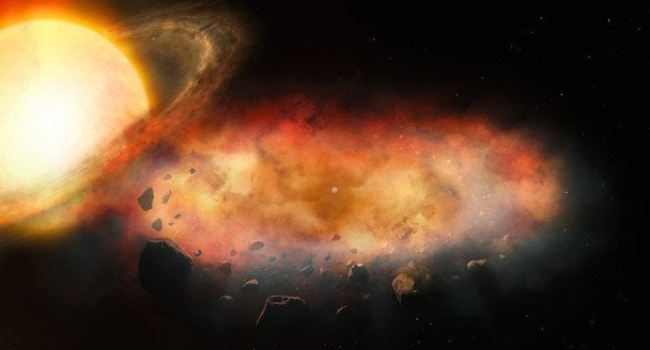
Astronomers from Johns Hopkins University have discovered a colossal cloud of vaporized metals that obscured the star J0705+0612 from September 2024 to May 2025, reducing its brightness to just 3 percent of its normal level. The cloud is about 200 million kilometers in diameter, roughly 15,000 times the diameter of Earth. The study was published in The Astronomical Journal.
How the object was discovered
The star J0705+0612, a Sun-like star located about 3,000 light-years away, suddenly dimmed by nearly a factor of 40. Such a deep and long-lasting dimming event is extremely rare. Astronomers used the Gemini South, Apache Point, and Magellan telescopes, along with archival data, to determine the nature of the object.
The cloud is located about 13.3 astronomical units from the star, roughly between the orbits of Saturn and Uranus in our Solar System. One full orbit around the star takes about 44 years.
What is inside the cloud
Spectral analysis using the high-precision GHOST instrument on Gemini South showed that the cloud is rich in heavy elements, referred to as “metals” in astronomical terminology. It contains large amounts of gaseous iron and calcium. For the first time, scientists were able not only to detect these metals but also to measure their motion within the cloud in three dimensions. The cloud rotates independently of the star.
What holds the cloud together
The cloud is gravitationally bound to a massive object orbiting J0705+0612. Its mass must be at least several times that of Jupiter; otherwise, such a vast structure would simply disperse. Two scenarios are considered possible:
- a low-mass companion star, in which case the cloud is a circumstellar disk;
- a giant planet, in which case it is a circumplanetary disk.
Both scenarios are extremely rare to observe when a disk or cloud passes directly in front of its star.
Origin of the cloud
The age of the system is estimated at about 2 billion years, but the cloud itself is likely much younger. The most probable cause is a collision between two planets. Such events are common in young and chaotic planetary systems but are extremely rare around stars of this age. The collision would have ejected dust, rocks, and gas, which then formed the cloud.
In brief
Astronomers have discovered a cloud of vaporized metals about 200 million kilometers in diameter that almost completely obscured the star J0705+0612 for nine months. The cloud is rich in iron and calcium, is held together by a massive object, either a giant planet or a low-mass star, and likely formed after a collision between two planets. For the first time, the motion of gas inside such an object has been measured. This exceptionally rare phenomenon adds a new element to our understanding of the dynamics of planetary systems.