make preferable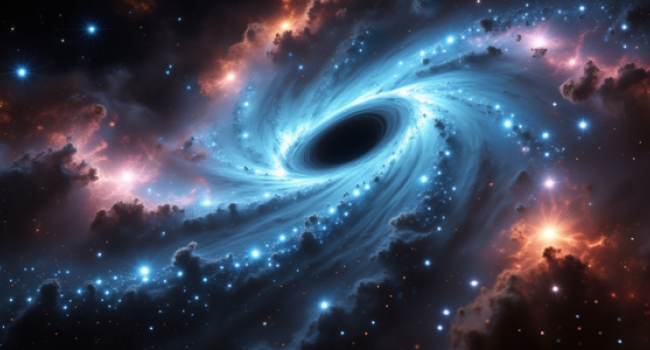
Astronomers are getting closer to definitively confirming the existence of “wandering” black holes—objects that are ejected from their host galaxies after powerful cosmic events and then race through intergalactic space at enormous speeds. New observations and analyses of gravitational waves show that these cosmic runaways are not science fiction but a real, albeit rare, phenomenon. This was reported by The Conversation.
How wandering black holes are born
The theoretical groundwork was laid back in the 1960s, when New Zealand mathematician Roy Kerr found a solution to Einstein’s equations of general relativity describing rotating black holes. It turned out that up to 29 percent of a black hole’s mass can be stored as rotational energy. Later, Roger Penrose demonstrated that this energy can be released, for example during the merger of two black holes.
Modern calculations show that when two black holes collide with certain orientations of their spins, gravitational waves carry away energy asymmetrically. As a result, the newly formed black hole receives a powerful gravitational “kick” and can be accelerated to thousands of kilometers per second, fast enough to escape its galaxy.
Direct evidence began to emerge after the LIGO and Virgo detectors started operating in 2015. Analyses of dozens of merger events revealed that many of them involve large amounts of rotational energy and chaotic spin orientations—exactly the conditions under which strong kicks are expected.
The first visual traces
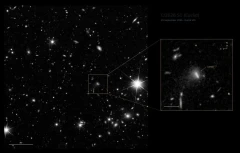
In 2025, astronomers reported the first visual evidence of this phenomenon. In several galaxies, they discovered long, almost perfectly straight trails of young stars. Scientists believe that a supermassive black hole passing through a galaxy compresses interstellar gas with its gravity, triggering bursts of star formation, much like the condensation trail left by a jet aircraft.
In one case studied by a team led by Pieter van Dokkum, a telescope detected a trail about 200,000 light-years long. This points to a black hole with a mass of roughly 10 million Suns moving at nearly 1,000 kilometers per second. In another galaxy, a more compact trail was found, likely produced by an object with a mass of about 2 million solar masses.
What this means for science and for us
If supermassive wandering black holes exist, then smaller ones should exist as well—nearly undetectable objects capable of traveling between galaxies. In theory, one of them could even pass through our Solar System, but the probability of this happening is vanishingly small.
Researchers emphasize that there is no reason for concern, as such events are extremely rare. Nevertheless, the discovery adds a new and unexpected element to our picture of the Universe, making it appear even more dynamic and surprising.
In short
Astronomers have identified the first visual traces of wandering black holes in the form of long chains of young stars left behind by supermassive objects ejected from their galaxies after mergers. Their speeds can reach around 1,000 kilometers per second, and their masses can be millions of times that of the Sun. Gravitational-wave data from LIGO and Virgo confirm that such powerful kicks are possible under certain spin configurations. This shows that the Universe is even more dynamic than previously thought, with black holes capable of traveling between galaxies. The chance of encountering one is negligible, but the phenomenon fundamentally changes our understanding of the cosmos.