make preferable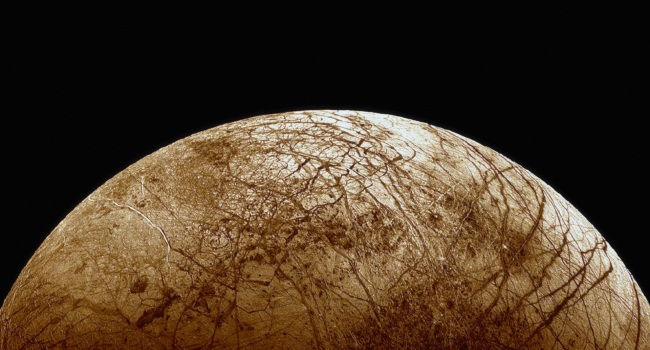
A new mechanism proposed by scientists at Washington State University explains how chemicals essential for life could be transported from Europa’s surface ice down into its subsurface ocean. The study was published on January 20, 2026, in The Planetary Science Journal.
Why this matters for the search for life
Europa is one of the top candidates for extraterrestrial habitability in the Solar System. Beneath its icy shell, which is tens of kilometers thick, lies a global ocean of liquid water—potentially containing twice as much saltwater as all the oceans on Earth combined. However, this ocean is completely isolated from sunlight and lacks oxygen, meaning any life there would have to rely entirely on chemical energy.
A central question has been how oxidants—compounds created on the surface by Jupiter’s intense radiation—can reach the ocean through the thick ice. Until now, it was thought that vertical mixing of the ice occurs only rarely, primarily during the formation of large cracks. Most of the surface behaves like a rigid “frozen lid,” blocking the downward transport of chemical compounds.
A new mechanism: “sinking” salty ice
The study’s authors, led by Austin Green (now at Virginia Tech), proposed an alternative process. They showed that areas of ice enriched with salts become both denser and mechanically weaker than the surrounding pure ice. Under the right conditions, these patches can break off and slowly sink—or “drip”—through the entire ice shell.
The process is called lithospheric foundering, analogous to a phenomenon on Earth in which sections of the lithosphere sink into the mantle, such as beneath the Sierra Nevada mountain range.
Modeling indicates that in an ice shell about 30 km thick, salty pockets in the upper 300 meters inevitably begin to sink. Depending on the extent of ice weakening, the process can initiate anywhere from 30,000 to 3 million years and reach the ocean over 5–10 million years.
Implications for habitability
Even a slow sinking of salty ice provides a continuous, if gradual, supply of oxidants to the ocean. This addresses a longstanding problem of how to supply chemical energy for potential life when the surface and ocean are separated by tens of kilometers of ice.
Green emphasized that the idea is inspired by a well-known terrestrial process and represents a new perspective in planetary science. He also suggested that it could solve one of Europa’s major habitability puzzles and is a promising sign for the prospects of life in its ocean.
Future research
NASA’s Europa Clipper mission, launched in 2024, is scheduled to arrive at Jupiter in April 2030. It will perform nearly 50 close flybys of Europa over four years, measuring ice thickness, ocean depth, and surface chemistry—data critical for testing this new hypothesis.
In brief
Scientists have proposed a mechanism in which salt-enriched patches of ice on Europa become denser and weaker, break off, and slowly sink through the ice shell to the ocean. This process supplies oxidants—key compounds for chemical energy—gradually over millions of years. It may begin in 30,000–3 million years and continue for up to 10 million years. The discovery provides a solution to the challenge of delivering chemicals to Europa’s isolated ocean and increases the moon’s potential habitability. The Europa Clipper mission in the 2030s will help confirm this mechanism.