make preferable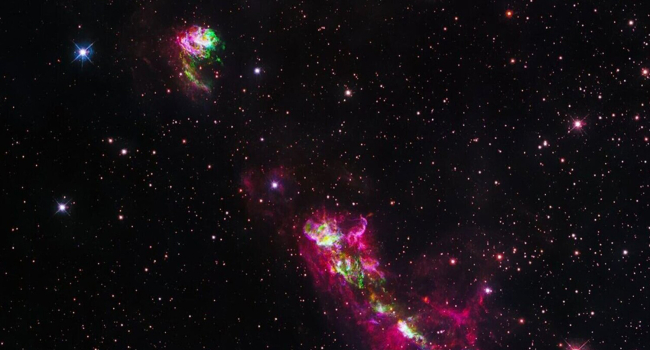
The Hubble Space Telescope has captured striking images of pink-green gas jets cutting through dark interstellar space. The Herbig–Haro objects HH 80 and HH 81 are among the brightest and most extended structures of this kind. NASA emphasizes: this is the longest known protostellar jet, moving at a record speed exceeding 1,000 km/s.
What Herbig–Haro Objects Are
Herbig–Haro objects form when narrow jets of ionized gas ejected by a young forming star (a protostar) collide with slower-moving material. Shock waves heat the gas, causing it to glow in visible and infrared light. HH 80/81 extend over 32 light-years — the longest protostellar outflow ever recorded.
The images were taken with Hubble’s Wide Field Camera 3, revealing fine structure, motion, and the evolution of the shock fronts with detail unavailable from other telescopes.
How These Jets Form
The protostar feeds on gas from its surrounding molecular cloud. Some of this material forms an accretion disk around the developing star. In the inner disk, ionized gas interacts with the protostar’s strong magnetic field, which channels plasma toward the poles, ejecting it as narrow jets at speeds up to 1,000 km/s.
HH 80/81 originate from the protostar IRAS 18162–2048 in the molecular cloud L291, located in the constellation Sagittarius about 5,500 light-years from Earth. With a mass 20 times that of the Sun, this protostar is the most massive known source of Herbig–Haro jets, most of which come from low-mass protostars.
Why It Matters
Observations provide a rare glimpse into the extreme conditions of massive star formation. Such jets influence the evolution of molecular clouds, triggering new star formation and regulating star birth in galaxies. The record length and speed of HH 80/81 offer critical insights into how magnetic fields and accretion operate in large-scale systems.
In brief
Hubble imaged the longest (32 light-years) and fastest (>1,000 km/s) protostellar jet, HH 80/81, from the massive protostar IRAS 18162–2048, 5,500 light-years away. The gas jets, shaped by magnetic fields and the accretion disk, collide with the interstellar medium creating shock waves. This discovery sheds light on massive star formation and their impact on galaxies.