make preferable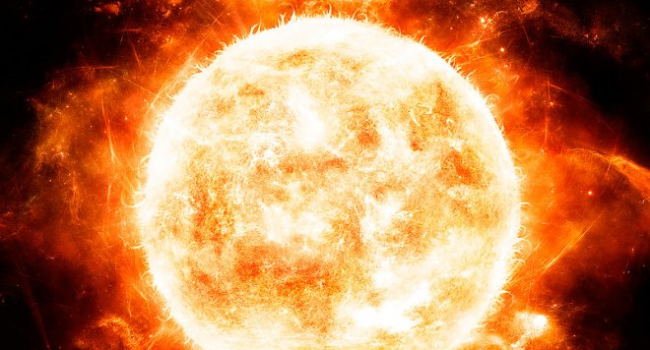
The Solar Astronomy Laboratory of the Space Research Institute of the Russian Academy of Sciences reported that a powerful active region has been observed on the far side of the Sun in recent days. Over four days, at least two very strong flares occurred there, presumably of X class, the highest level. Within the next two days this region will rotate into view from Earth, after which scientists will be able to assess its true strength.
What is happening on the Sun
Last night, a flare of class M3.3 was recorded in the same region. Since the active center was almost beyond the solar limb, a significant part of the radiation was blocked by the solar disk. For this reason, the observed power was most likely strongly underestimated. Precise measurements are not yet possible because there are currently no satellites that monitor the far side of the Sun.
In the coming days, when the region turns toward Earth, scientists will obtain a complete picture. Only then will it be possible to make a reliable forecast of geomagnetic activity for the week ahead.
Impact on Earth
A leading researcher at the Space Research Institute, Natan Eismont, explained in an interview with aif.ru that not all flares and plasma ejections pose a threat. Only sufficiently powerful coronal mass ejections are dangerous, when dense clouds of plasma reach Earth and cause geomagnetic storms.
He clarified that certain events on the Sun can affect the state of near-Earth space, particularly powerful bursts or flares in the solar corona that eject plasma. If these plasma clouds reach Earth and are strong enough, they contribute to the formation of magnetic storms.
He also noted that magnetic storms can influence the well-being of some people, but such individuals represent a minority. In general, solar flares are a regular natural phenomenon.
He emphasized that solar activity of this kind should be seen as a normal part of the Sun’s behavior.
At the moment, any impact of the already observed flares on Earth is completely ruled out.
In brief
Powerful flares, including ones of X class, have been recorded on the far side of the Sun in recent days. Within the next two days, the active region will rotate into view from Earth, allowing scientists at the Space Research Institute to accurately assess its parameters and issue a forecast for the coming week. For now, any impact on Earth is excluded. According to Natan Eismont, strong coronal mass ejections can cause magnetic storms that may affect the well-being of people sensitive to space weather, but solar flares themselves are a normal feature of solar activity.