make preferable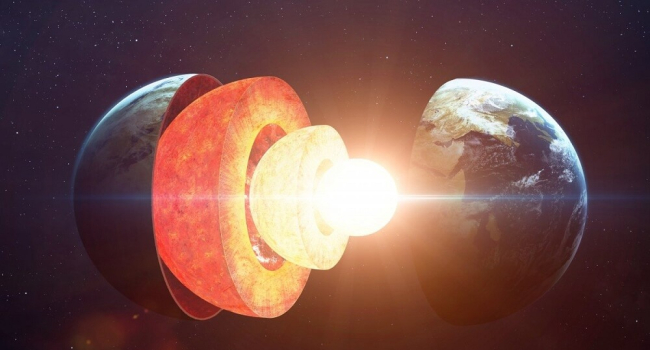
At a depth of about 2,900 kilometers, near the boundary between Earth’s core and mantle, scientists have identified ultra-low velocity zones (ULVZs) — small regions with highly unusual properties. A new study shows that these zones act as thermal insulators, altering heat flow and potentially influencing the geodynamo, the mechanism that generates Earth’s magnetic field. The research was published in Nature Communications.
What Are Ultra-Low Velocity Zones?
ULVZs are “pockets” tens of kilometers high and hundreds of kilometers wide, attached to the base of the lower mantle. Seismologists have known about them for years: seismic waves travel unusually slowly through these regions, and their density is higher than that of surrounding material. However, their role in global Earth processes remained unclear.
A team led by Wen-Ping Hsieh of National Taiwan University measured the thermal conductivity of iron-rich magnesiowüstite, a mineral believed to dominate ULVZs. Using diamond anvil cells, the researchers recreated the extreme pressure and temperature conditions found deep inside Earth.
The result was striking: the mineral’s thermal conductivity turned out to be exceptionally low — far lower than that of the surrounding mantle. In effect, ULVZs behave like localized “blankets,” slowing the escape of heat from the core.
“Such zones can significantly modify the distribution of heat flow at the core–mantle boundary and may even cause localized thermal stratification in the upper part of the core,” Hsieh explained.
This has direct implications for the geodynamo — convection in the liquid outer core that generates Earth’s magnetic field and shields the planet from the solar wind.
Why This Changes Our Understanding
ULVZs are not just geological curiosities. They influence Earth’s thermal balance and the long-term evolution of its magnetic shield. The authors acknowledge that much about Earth’s “internal engine” remains unknown.
“We still know very little about how Earth’s internal engine works, and there is much more work ahead,” Hsieh noted.
The study shows that even relatively small structures deep within the planet can control global processes — from Earth’s thermal history to the stability of its magnetic field.
In Brief
Ultra-low velocity zones at the core–mantle boundary act as thermal insulators that alter energy flow and affect the geodynamo. Experiments confirmed the unusually low thermal conductivity of magnesiowüstite in these regions. The findings help explain the evolution of Earth’s magnetic field and interior — but many mysteries remain. The depths of our planet continue to surprise scientists.