make preferable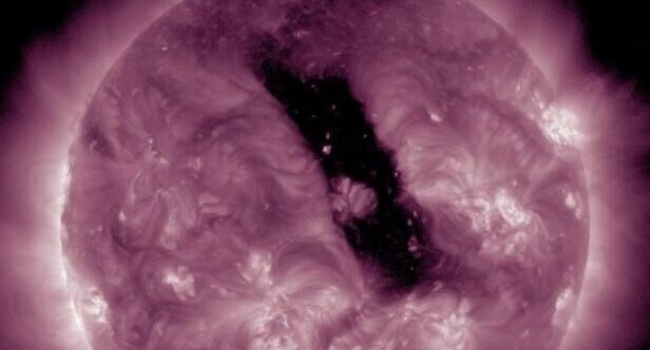
After a series of powerful solar flares, the Sun has temporarily calmed down, but it is too early to relax. A large coronal hole of unusual shape has formed on the visible solar disk. According to the Laboratory of Solar Astronomy at the Space Research Institute of the Russian Academy of Sciences, a stream of fast particles from this region will reach Earth on December 17–18 and may trigger geomagnetic storms of moderate strength.
What Is a Coronal Hole and Why Is It Dangerous?
Coronal holes are regions on the Sun where magnetic field lines are open, allowing solar wind to escape into space at much higher speeds, up to 800 km per second compared to the usual 400 km per second. When such a hole rotates toward Earth, the stream of charged particles bombards the magnetosphere, causing disturbances.
“The absolutely bleak picture of the solar winter in the coming days will likely be somewhat relieved by a fairly large coronal hole of a very peculiar shape that has formed on the solar disk,” the Space Research Institute noted.
Solar flare activity is currently close to zero. After four M-class flares several days ago, the Sun has quieted down. However, coronal holes are often responsible for prolonged, though not extreme, geomagnetic storms.
What to Expect on December 17–18
Disturbances at the G1 to G2 level, from weak to moderate, are expected, with a possible rise to G3 during certain hours. This means:
- bright auroras visible as far south as mid-latitudes, including Moscow and Saint Petersburg
- minor disruptions to radio communications and GPS
- possible headaches and discomfort for weather-sensitive individuals
This event will not compare to the extreme G5 storm on November 12, with a Kp index of 8.67, the strongest in 20 years, but it will still be noticeable.
2025 Is a Record Year for Solar Activity
Over the past year, Earth has experienced several major events, including G5 storms in May 2024 and November 2025, as well as numerous G3 and G4 storms. This marks the peak of Solar Cycle 25, which has proven to be more active than expected.
In Brief
A coronal hole of unusual shape is expected to cause G1–G2 geomagnetic storms, with a possible increase to G3, on December 17–18, following a lull in solar flare activity. Auroras and minor communication disruptions are likely. The year 2025 continues to set records for solar activity, so monitoring forecasts from the Space Research Institute is advised.