make preferable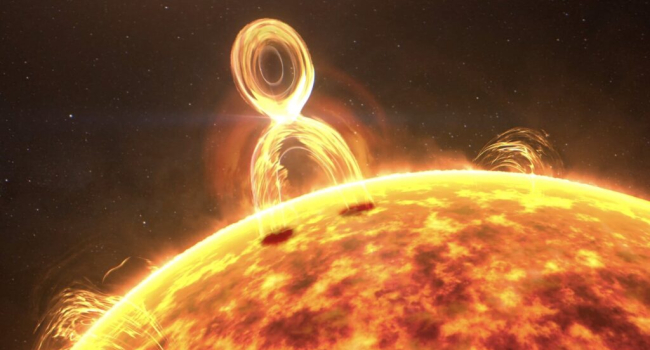
On December 9, 2025, the Sun produced nine M-class flares in a single day, a record for recent weeks. According to the Institute of Applied Geophysics, two of them occurred during daylight hours, increasing their impact on space weather. Astronomers warn that a plasma cloud from earlier events is approaching Earth, and the first effects may appear this evening.
Nine M-Class Flares: What Happened
By midday on December 9, seven M-class flares had already been recorded, and by evening the total reached nine. The two most recent were from sunspot group 4294 (S12W46 and S13W52): an M1.2 flare at 11:05 Moscow time lasting 17 minutes, and an M1.5 flare at 18:14 lasting 32 minutes. These events occurred in a massive sunspot complex that has been keeping the Sun at elevated activity levels since October 2025.
M-class flares are the second-highest category on the scale (A, B, C, M, X). They release energy equivalent to billions of atomic bombs and generate radiation ranging from radio waves to gamma rays. Although they are not as destructive as X-class flares such as the one on December 8, their cumulative effect intensifies geomagnetic disturbances.
Incoming Storm: G2–G3 on December 9–10
A plasma cloud from the M8.1 flare on December 6 is expected to reach Earth today, triggering a geomagnetic storm rated G2–G3 (moderate to strong). The probability is 96 percent, with the peak expected in the second half of December 9 and continuing through December 10. The Kp geomagnetic index may reach 6–7.
Expected effects include:
• auroras visible as far south as Moscow and Saint Petersburg
• disruptions in shortwave radio and GPS
• potential issues in power grids
• headaches and insomnia for weather-sensitive individuals
This is already the third strong storm of December, following the G5 event on November 12 and the G3 on December 1. The year 2025 is breaking records for solar activity.
Summary
On December 9, the Sun produced nine M-class flares, including two during daylight hours. A plasma cloud from the M8.1 flare is expected to trigger a G2–G3 geomagnetic storm with a 96 percent probability, peaking on the evening of the 9th and throughout the 10th. Auroras, communication disruptions, and effects on well-being are likely. The year 2025 marks the peak of solar activity.