make preferable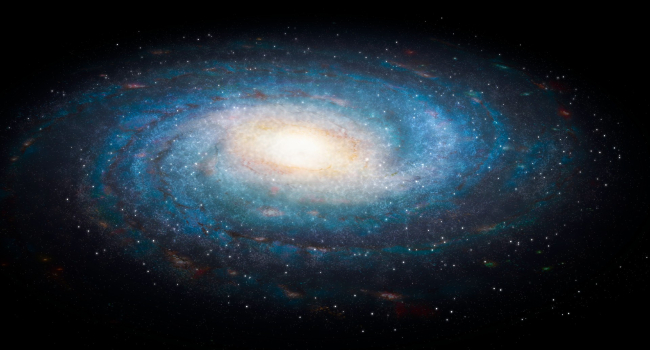
Astronomers from the University of Barcelona have used cosmological simulations to finally clarify the nature of the Milky Way’s puzzling chemical bimodality: stars fall into two distinct groups based on their magnesium-to-iron ratio (Mg/Fe), even though they overlap strongly in overall metallicity. The study was published in Monthly Notices of the Royal Astronomical Society.
Two Sequences Instead of One
In the Solar neighborhood, stars form two parallel branches on the [Mg/Fe]–[Fe/H] diagram: one is magnesium-rich (low metallicity, older disk stars), and the other is magnesium-poor (younger stars). For decades the second branch was thought to have emerged due to a merger with the dwarf galaxy Gaia-Sausage-Enceladus about 10 billion years ago. But new simulations from the Auriga project show that this is not the only — or even a required — explanation.
How Simulations Solved the Puzzle
The team modeled 30 galaxies similar to the Milky Way and found that bimodality can appear through two mechanisms:
• alternating periods of intense star formation and long periods of quiescence;
• sharp changes in the inflow of low-metallicity gas from the outer halo.
In both cases, the arrival of fresh gas dilutes the interstellar medium, altering the chemical composition of newly formed stars and producing a second sequence — without any need for catastrophic mergers.
Lead author Matthew Orkney explained in the paper that the study shows the Milky Way’s chemical structure is not a universal template. He pointed out that different galaxies can reach similar outcomes through entirely different evolutionary paths, and that this represents an important step toward understanding galactic evolution.
The authors also emphasized that the shape and slope of these chemical sequences act like a “fingerprint” of a galaxy’s star-formation history. In the coming years, telescopes such as 4MOST and WEAVE will test these predictions in other galaxies.
Co-author Shervin Laporte noted that the team expects to find a wide variety of such chemical sequences elsewhere in the Universe, and that these observations will help refine the evolutionary history of the Milky Way itself.
In Brief
Auriga simulations suggest that the Milky Way’s chemical “split” in Mg/Fe can arise without any merger with Gaia-Sausage-Enceladus. Alternating bursts of star formation and inflows of fresh halo gas are sufficient to create two parallel chemical sequences. This offers a new way to “read” a galaxy’s history through its stellar chemistry.