make preferable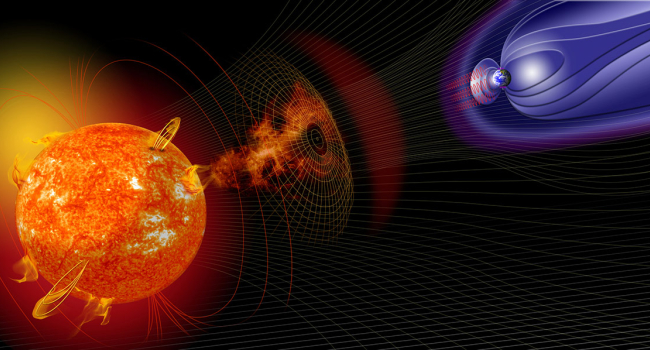
The Solar Astronomy Laboratory of the Space Research Institute of the Russian Academy of Sciences has warned that on Tuesday, December 9, 2025, Earth’s magnetosphere will remain in a G2.7 (moderate to strong) geomagnetic storm state throughout the entire day. The probability of the event is estimated at 96%, with the main impact expected from 10:00 to 19:00 Yerevan time (09:00 to 18:00 Moscow time).
Why This Is Happening Now
Following the record-breaking G5 storm on November 12 (Kp = 8.67 — the highest level in 20 years), the Sun has not stabilized. New active regions continue to emerge on its visible side, and older regions responsible for November’s events are still producing coronal mass ejections. According to calculations by NOAA and the Space Research Institute, one of these ejections is expected to reach Earth on December 9.
Although a G2.7 storm is not classified as extreme (G5 is the maximum), it may still trigger:
- bright auroras visible as far south as Moscow and St. Petersburg,
- disruptions in shortwave radio communications,
- minor fluctuations in power grids,
- slight issues with GPS navigation.
Meteorologically sensitive individuals may experience headaches, blood pressure fluctuations, and sleep disturbances.
2025 Is a Record Year for Strong Storms
Over the past 13 months, Earth has already experienced three G4–G5-level events — more than in the previous 15 years combined. The storms of May 2024 and November 2025 are now considered “planetary-scale events.” Scientists link this surge in activity to Solar Cycle 25, which has turned out to be unusually intense.
In Brief
On December 9, 2025, Earth is expected to undergo a G2.7 geomagnetic storm with a 96% probability, lasting all day and peaking between 09:00 and 18:00 Moscow time. Bright auroras and minor disruptions in communications and navigation systems are likely. The year 2025 continues to break solar activity records, marking the third major storm in just 13 months.