make preferable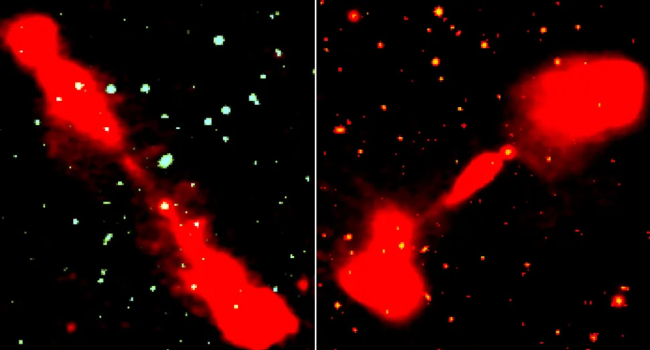
Indian astronomers from Midnapore City College and other institutions have announced the discovery of 53 new giant radio quasars — supermassive black holes ejecting relativistic jets up to 7.2 million light years long. This is twenty to fifty times larger than the diameter of the Milky Way. In recent years, a total of 369 such objects have been found using the Giant Meterwave Radio Telescope (GMRT) in Pune, but this new sample of 53 is the most impressive in size. The study was published on November 13, 2025, in The Astrophysical Journal Supplement Series.
What giant radio quasars are and why they are so difficult to find
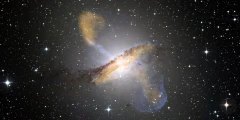
At the center of almost every large galaxy sits a supermassive black hole. When it actively feeds on gas and dust, an accretion disk forms, shining brighter than billions of stars. This is what we call a quasar. Part of the matter does not fall inward; instead, under the influence of powerful magnetic fields, it is ejected toward the poles as narrow relativistic jets. At distances of hundreds of thousands and millions of light years, these jets expand into enormous radio lobes that emit in the radio band.
“The sizes of these radio jets are incomparable not only to the Solar System but even to our entire galaxy,” says team member Souvik Manik. “We are talking about twenty to fifty Milky Way diameters placed side by side.”
The main difficulty in identifying them is that the faint “bridge” emission between the lobes often gets lost in background noise, making the structure appear disconnected. Low frequency surveys by GMRT (150 to 1400 megahertz) are ideal for this, as the old synchrotron plasma in the lobes shines more brightly at low frequencies.
Key findings
Among the 53 new giants:
• Jets up to 7.2 million light years long — an absolute record among known objects
• At least fourteen percent are located inside galaxy clusters or near cosmic filaments
• Strong asymmetry of jets is observed: one jet is often shorter and dimmer than the other
• The farther the quasar (that is, the earlier the cosmic epoch), the stronger the asymmetry — the early Universe was denser and more chaotic
“Their enormous radio jets make these quasars invaluable for understanding the late stages of their evolution and the intergalactic environment in which they expand,” emphasized study lead Sabyasachi Pal.
“This asymmetry tells us that the jets are battling an uneven cosmic medium,” added Sushanta K. Mondal. “On one side, a jet can crash into dense clouds of intergalactic gas, slowing down, while on the other side it can expand freely in a more rarefied medium.”
In short
Using GMRT, scientists have discovered 53 giant radio quasars with jets up to 7.2 million light years long, fifty times wider than the Milky Way. They reveal how supermassive black holes pierce through the intergalactic medium and confirm that in the early Universe, jets were more strongly distorted by dense gas. This is one of the most far reaching discoveries of 2025 in the field of active galactic nuclei.