make preferable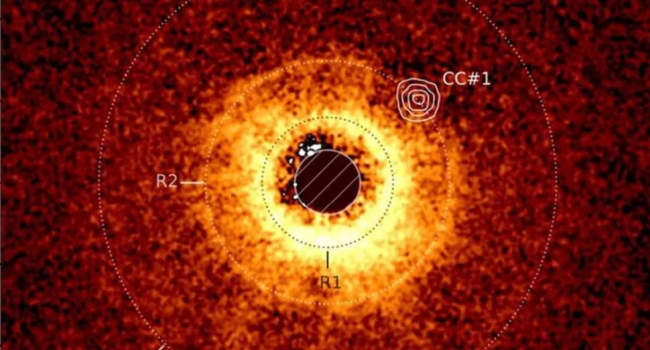
The James Webb Space Telescope (JWST), launched three years ago, has achieved a major breakthrough by discovering its first exoplanet — TWA 7b. This object is not only the first new world found by the telescope, but also the lightest exoplanet ever directly imaged. The study, published in Nature, reveals the details of the discovery and highlights JWST’s unique capabilities.
TWA 7b: The Lightest Directly Imaged Exoplanet
TWA 7b is located in the system of the young star CE Antliae (TWA 7), situated 111 light-years from Earth. The mass of TWA 7b is about 100 Earth masses, or 0.3 Jupiter masses, making it ten times lighter than any exoplanet previously directly photographed. This marks an important step in the study of low-mass planets, which are typically difficult to detect due to their faint emissions.
The star CE Antliae, discovered in 1999, is only a few million years old — an infant compared to our 4.6-billion-year-old Sun. This young star is surrounded by a protoplanetary disk — a ring of dust and gas from which planets form. Uniquely, the system is oriented “top-down” (or “bottom-up”) from Earth’s perspective, allowing astronomers to study the disk’s structure in detail.

How Was TWA 7b Discovered?
The protoplanetary disk around CE Antliae consists of three rings, one of which is narrow and flanked by two "gaps" that are almost devoid of material. It was in this narrow ring that the James Webb Telescope detected a source of infrared radiation. Scientists determined that this is most likely a young exoplanet. Computer simulations confirmed that the presence of TWA 7b explains the formation of the narrow ring and the surrounding gaps in the disk, perfectly matching the observations.
JWST is ideally suited for such discoveries thanks to its sensitivity to infrared radiation, which is emitted by young, low-mass planets. Direct imaging of exoplanets is challenging because their faint light is overwhelmed by the brightness of their host stars. However, JWST is equipped with a coronagraph, which blocks the star’s light and allows its Mid-Infrared Instrument (MIRI) to capture the weak emissions from planets. This made it possible to image TWA 7b for the first time, despite its low mass.
Why Is This Discovery Important?
The discovery of TWA 7b is significant for several reasons:
- Studying planet formation: The protoplanetary disk of CE Antliae shows how planetary gravity shapes rings and gaps. TWA 7b confirms that even low-mass planets can significantly influence disk structure.
- Understanding the young solar system: The CE Antliae system resembles the early solar system, and studying it helps scientists understand how planets — including Earth — formed.
- The potential of JWST: The discovery of TWA 7b is just the beginning. The $10 billion telescope is capable of detecting even lighter planets, expanding our knowledge of exoplanet diversity.
Context: The Role of Protoplanetary Disks
Protoplanetary disks are clouds of gas and dust surrounding young stars, from which planets and asteroids form. They consist of:
- Gas: Mainly hydrogen and helium, providing the disk’s mass.
- Dust: Microscopic particles that clump together to form planetesimals — the seeds of planets.
- Volatile substances: Water, methane, and organic molecules that may become the basis for life.
In the case of CE Antliae, the disk is divided into rings, indicating the presence of planets whose gravity “clears out” material, creating gaps. Similar structures have been observed in other systems, such as HL Tauri, photographed by the ALMA telescope. TWA 7b confirms that these processes are universal and occur even around stars with masses similar to the Sun’s.
Prospects and Future Research
Scientists are confident that TWA 7b will not be JWST’s last discovery. The telescope will continue studying young star systems to find more low-mass exoplanets. Additional data may come from:
- The Vera Rubin Observatory: Its first images, taken on June 23, 2025, have already revealed thousands of new asteroids, and future observations may complement data on protoplanetary disks.
- Space missions: For example, the CROWN mission, initially planned to study asteroids near Venus, could be adapted to observe objects in other inner systems.
Furthermore, analyzing the composition of TWA 7b — including the possible presence of volatiles such as methanol (as recently detected in the HD 100453 system) — may offer clues about the potential habitability of such planets.
Conclusion
The discovery of the exoplanet TWA 7b by the James Webb Telescope is a landmark event in astronomy. This lightweight planet, found in the protoplanetary disk of the star CE Antliae, not only showcases JWST’s capabilities but also deepens our understanding of planet formation processes. The telescope’s unique ability to image infrared radiation opens a new era in the search for exoplanets, promising many future discoveries. TWA 7b is just the first step toward unraveling the mysteries of planetary system formation — and perhaps even the origins of life in the universe.