make preferable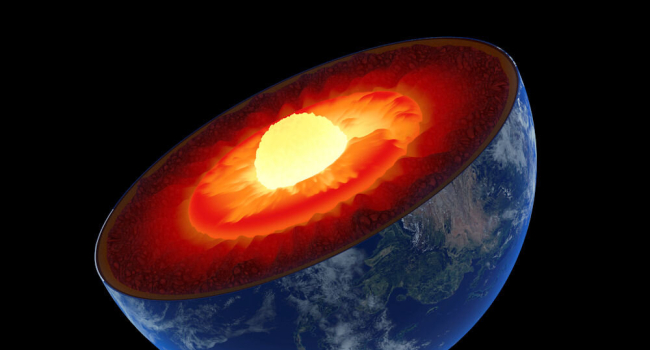
A new study by an international team of scientists, published in Nature, sheds light on the mystery of two massive anomalies in Earth's mantle. It turns out that these enigmatic structures could be remnants of an ancient planet that collided with Earth 4.5 billion years ago, leading to the formation of the Moon.
What Are the Anomalies Hidden Deep Within Earth?
Back in the 1980s, seismologists discovered two enormous structures deep inside Earth—one beneath the Pacific Ocean and the other beneath Africa. These formations, known as large low-velocity provinces (LLVPs), have puzzled scientists because they slow down seismic waves, indicating they are significantly hotter than the surrounding mantle.
Until recently, researchers believed these zones were composed of ancient tectonic plates that had sunk into the mantle millions of years ago. However, the new study challenges this hypothesis.
What Did the New Research Reveal?
By analyzing data from 104 earthquakes, scientists studied how seismic waves lose energy as they pass through these structures. They discovered that energy loss in these regions is minimal, suggesting an unusual mineral composition.
According to lead author Sujania Talavera-Soza from Utrecht University, the smaller the grains in a rock, the more seismic waves weaken. However, in these anomalies, we observe the opposite—meaning their composition is fundamentally different from the surrounding mantle.
Unlike tectonic plates, which have a fine-grained structure, these anomalies contain much larger mineral grains. This suggests that they are not part of Earth's crust, but rather remnants of an ancient celestial body that crashed into Earth in its early history.
How Does This Change Our Understanding of Earth?
This discovery changes our understanding of Earth's history and its internal structure, says seismologist Arwen Deuss.
Moreover, the study suggests that Earth's mantle is far more stable than previously believed. If these structures have remained intact for billions of years, it means that mantle convection and material mixing occur much more slowly than scientists had thought.
Now, researchers plan to investigate how these mysterious formations influenced Earth's evolution and whether they truly contain remnants of the ancient planet that gave birth to the Moon.