make preferable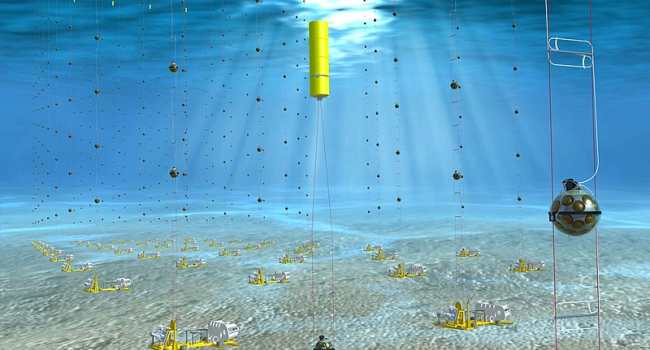
An international team of scientists has begun building giant underwater telescopes on the floor of the Mediterranean Sea to detect and study high-energy neutrinos, tiny particles that could shed light on the mysteries of the cosmos. The results of the project have been published in the Journal of High Energy Physics (JHEP).
What are neutrinos and why are they important?
Neutrinos are subatomic particles with almost zero mass and electric charge. They are produced during nuclear reactions inside stars, in supernova explosions, and even in the Earth’s atmosphere. Due to their weakly interacting nature, neutrinos are able to pass through matter with virtually no interference, making their study challenging but incredibly valuable. It is believed that these particles can provide unique information about the origins and structure of our Universe.
KM3NeT Project: Telescope Design
The KM3NeT (Cubic Kilometre Neutrino Telescope) project involves installing two massive underwater telescopes off the coast of Sicily and southern France. Each telescope consists of hundreds of glass spheres suspended on cables up to 700 meters long. Inside the spheres are photomultipliers, highly sensitive sensors that record the faint flashes of light that occur when neutrinos interact with water molecules.
At present, 57 cables have been installed, but in the future their number will increase to several hundred, creating a giant “underwater forest” in the pitch darkness at a depth of one kilometer. The Sicilian telescope will study cosmic neutrinos, and the French telescope will study neutrinos formed in the atmosphere. This distribution will allow us to study oscillations - the transformation of one type of neutrino into another. Unique features of the project
KM3NeT will be a marine analogue of the IceCube observatory located in Antarctica, where the detectors operate in an icy environment. However, installing equipment on the seabed requires no less complex operations. Every year, scientists conduct month-long expeditions to install new cables. The spheres are lowered to the seabed using ship cranes and underwater vehicles, and each step requires precision, since it is impossible to correct errors after installation.
Physicist Simone Biaggi noted that the process of installing telescopes can be compared to sending a device to the Moon. Despite the technical and financial difficulties, the team remains enthusiastic, inspired by the views of the Mediterranean Sea and the awareness of the significance of their mission.
Why is this important for science?
The construction of underwater neutrino telescopes will open new horizons in the study of the Universe. By catching rare interactions of neutrinos with matter, scientists will be able to obtain vital information about the most powerful cosmic phenomena, such as supernova explosions, as well as about the fundamental laws of physics. This is why the KM3NeT project promises to become an important tool for revealing the secrets of space and will make a significant contribution to the development of astrophysics.