make preferable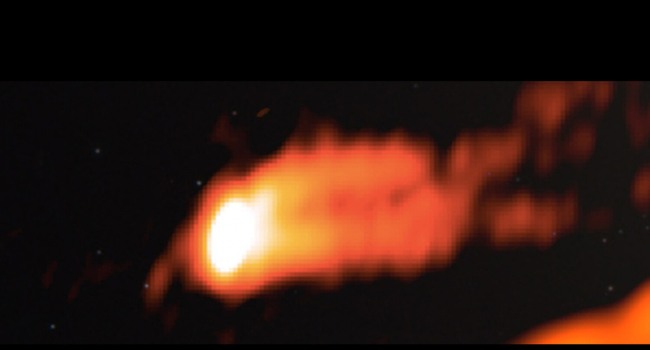
An international team of scientists studying the supermassive black hole in the galaxy M87 accidentally captured a rare event—a powerful gamma-ray burst triggered by the black hole’s activity. The study was published in the journal Astronomy & Astrophysics.
The Galaxy M87 and Its Supermassive Black Hole
M87 is located about 55 million light-years away from us. At its center lies a black hole actively consuming matter from a surrounding cloud of gas and dust. This activity is accompanied by the release of powerful astrophysical jets—streams of plasma ejected at near-light speeds.
How Did the Explosion Occur?
Jets are formed through the interaction of matter with the black hole’s magnetic field. Some of the material from the accretion disk—a structure orbiting the black hole—is accelerated along magnetic field lines and ejected into space. Occasionally, high-energy “bubbles” of matter in the jets burst, creating gamma-ray flares.
According to scientists, such events are impossible to predict—they can only be recorded by chance.
The gamma-ray burst observed was the first detected in the last 10 years. It lasted three days, and the source region was extraordinarily compact—about 10 times the diameter of the black hole.
What Did the Observations Reveal?
During the burst, scientists noticed changes in the asymmetry of the light ring around the black hole. Some areas became brighter, while others dimmed. This indicates a connection between the gamma-ray burst and the structure of the black hole’s surroundings. However, the exact mechanism of this link remains a mystery.
Researchers were able to determine the size of the region responsible for the gamma emission. This revealed the complex structure of the burst zone, which behaves differently depending on the wavelength of observation.
Why Is This Important?
This new discovery will help scientists test theories about the origins of gamma-ray bursts and deepen our understanding of the processes occurring near the event horizon—the boundary beyond which neither matter nor light can escape the black hole’s gravitational pull.
How and where particles are accelerated in the jets of supermassive black holes is one of the key questions in astrophysics, said astrophysicist Daniel Mazin of the University of Tokyo, a co-author of the study.
This data marks a significant step in studying the behavior of matter and energy under extreme conditions and could lead to new discoveries about the nature of black holes and their impact on the surrounding cosmos.