make preferable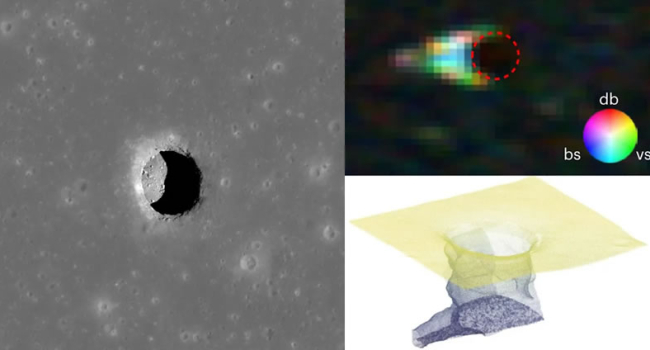
Italian astronomers have made a discovery that could change lunar exploration plans. Analysis of data from a lunar orbital probe has revealed a subsurface cave that could be an ideal location for establishing a lunar base.
A team of scientists led by Leonardo Carrer and Lorenzo Bruzzone studied radar images of the lunar surface taken in 2010 using NASA's Lunar Reconnaissance Orbiter (LRO). The researchers concluded that the signal reflection in one area indicates the presence of an underground cavity or tunnel stretching for dozens of meters, as reported by TechCrunch.
The discovered cave is located about 100 meters deep in the Sea of Tranquility, near the Apollo 11 landing site. According to scientists, it could provide reliable protection from radiation, meteors, and extreme temperature fluctuations on the lunar surface. Until recently, such tunnels existed only in theory, but now there is real evidence of their existence.
"This discovery turns theory into reality. Designing a habitat module inside such a lunar cave is now a very feasible task," note the authors of the study published in the journal Nature Astronomy. Experts believe that this discovery could significantly impact NASA and private companies' plans for establishing long-term lunar settlements. A surge of interest in developing technologies for exploring and utilizing lunar caves is expected.
However, scientists caution that while the discovery of the lunar cave is a significant step forward in lunar exploration, it does not guarantee success, as the cave is located deep within a crater, complicating access. Its size is unknown, and it may be too small or unsuitable for settlement due to debris and dust. Nevertheless, the mere fact of its existence opens new perspectives and could be a turning point in planning future missions.