make preferable
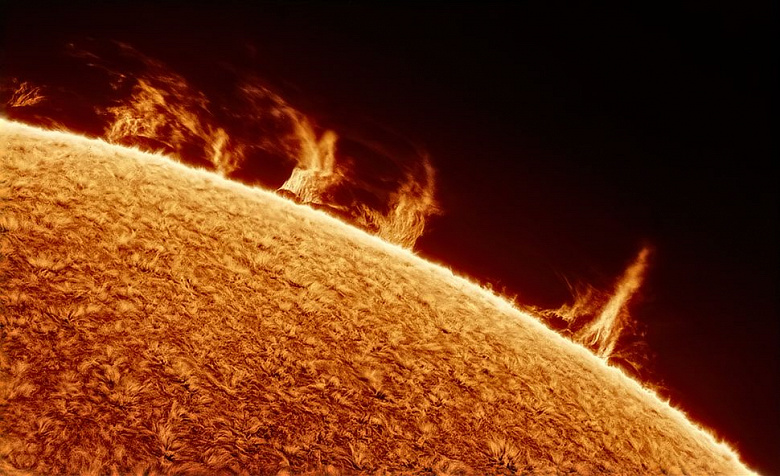
Astrophotographer Mark Johnston has created incredibly detailed photographs of the Sun, showcasing its turbulent nature ahead of the solar maximum. Johnston captured these images in his backyard in Scottsdale, Arizona.
The Sun is currently in the solar maximum phase, when solar activity peaks during its 11-year cycle. During this time, the Sun produces massive sunspots, powerful solar flares, and coronal mass ejections (CMEs), leading to impressive large-scale auroras.
Johnston took these images on July 2, revealing a highly detailed chromosphere with erupting solar prominences and filaments. He describes these images as "an abundance of details that captivates: solar prominences, active regions, sunspots, filaments, and spicules—all of which change from day to day." Johnston said, "I enjoy photographing the Sun because it is the only object in astronomy that looks different every time you see it."
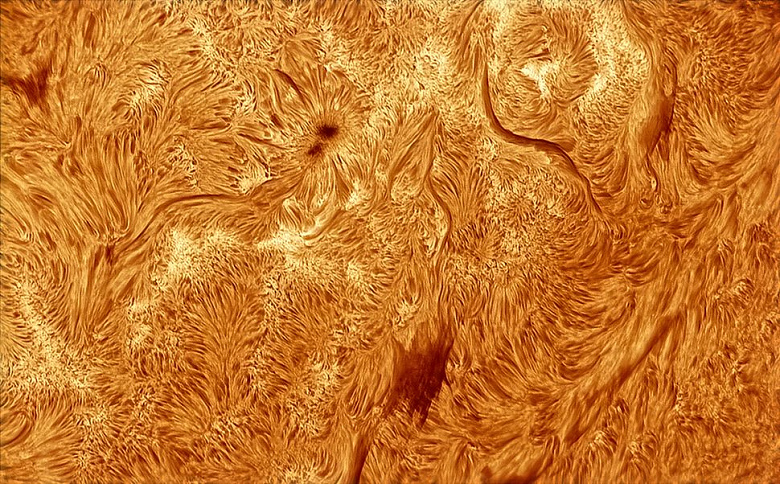
In the first image, a close-up shows a pair of bright sunspots next to glowing arcs of plasma, known as filaments, that have broken away from the surface. Johnston noted, "The large dark square 'canopy' of plasma in the bottom right corner is big enough to cover 25 Earth-sized planets." He also described it as "an absolutely unique spectacle that never repeats."
The second image shows a line of solar prominences moving across the Sun's surface. Johnston described this as "small feathery spicules that appear and disappear within minutes." According to NASA, these spicules can reach lengths of 9,600 kilometers and eject streams of solar material at speeds of 96 km per second.
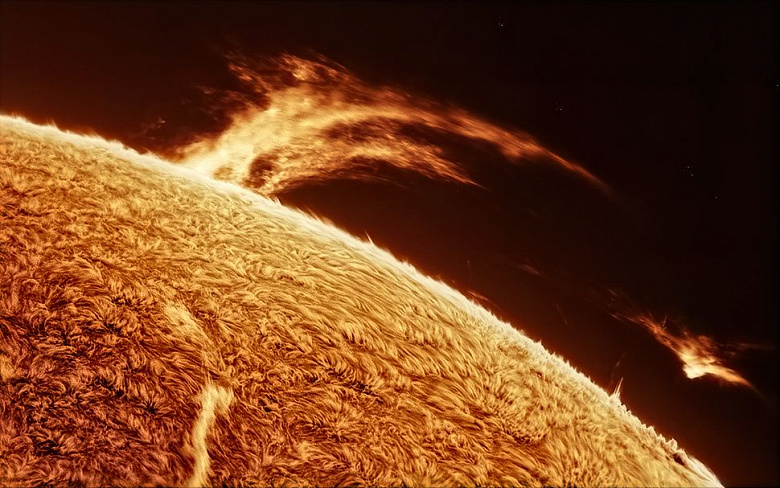
The third image depicts a huge prominence arching across the Sun. Johnston noted, "On the right, millions of tons of plasma have detached from the Sun and are floating above the surface." The looped material we see is plasma, a hot gas composed of electrically charged hydrogen and helium.
Johnston used a 160mm refractor telescope and a high-speed monochrome camera to capture 2,000 10-millisecond frames for each image. During post-processing, the best 200 frames from each sequence were stacked to create a single image. Additional enhancements and sharpening techniques were then applied.