make preferable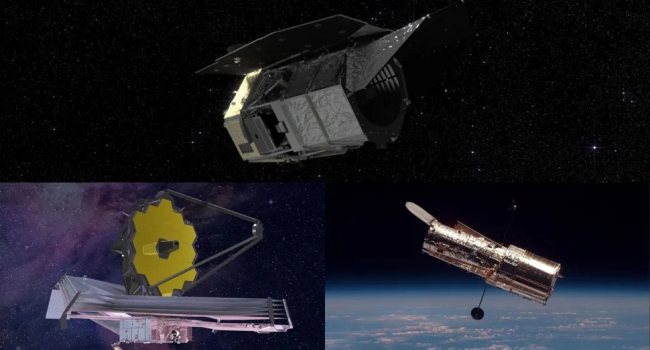
NASA’s newest space observatory, the Nancy Grace Roman Space Telescope, is set to launch from Cape Canaveral in the coming weeks. The 12.7-metre spacecraft is scheduled to lift off on 30 August aboard a SpaceX Falcon Heavy rocket. Its primary mission is not merely to produce striking images, but to survey vast swaths of the sky and help scientists tackle some of cosmology’s biggest questions—dark matter, dark energy, and planets orbiting other stars, reports Space.com.
How Roman Differs from Hubble and James Webb
Roman’s defining advantage is its speed and survey breadth. According to NASA Administrator Jared Isaacman, its imaging capabilities are more than a thousand times faster than Hubble’s. What would take Hubble two millennia to accomplish, Roman can complete in a single year. The data volume is equally impressive: in one year, the telescope will collect roughly 500 terabytes of information. By comparison, Hubble has amassed about 400 terabytes over its 35-year operational lifetime.
Roman’s mirror has a diameter of 2.4 metres—matching Hubble’s—yet it is roughly 80 percent lighter. Its primary instrument, the Wide-Field Instrument (WFI), operates in the infrared, like JWST. However, the WFI’s field of view is about a hundred times wider than that of Hubble’s infrared instrument and roughly fifty times wider than JWST’s.
This is the essential distinction. JWST is designed to peer deep into narrow patches of sky with exceptional detail. Roman, by contrast, will cover enormous areas, albeit with less depth. It can simultaneously capture supernovae, fast radio bursts, colliding neutron stars, and gravitational-lens candidates.
Why Such a Wide Field Matters
The Universe is a dynamic place, with many events occurring at once. While one telescope intently studies a distant galaxy, an important supernova or another rare event could flare up in an adjacent region of the sky. A narrow field forces astronomers to make difficult choices about where to point. Roman removes that constraint: it will generate a kind of "hot-spot map" of the cosmos, which Hubble, JWST, or other observatories can then target for detailed follow-up.
Moreover, a comprehensive survey of billions of galaxies will yield deeper insights into how dark matter holds galaxies together and how dark energy accelerates the expansion of the Universe. Roman will be able to construct three-dimensional "timelapses" of cosmic structure, revealing how the distribution of matter changes over time.
A Unique Coronagraph for Exoplanet Hunting
The telescope’s second instrument is a coronagraph. It acts like an artificial eclipse, blocking a star’s intense glare and allowing astronomers to discern objects in its immediate vicinity. NASA estimates that Roman’s coronagraph will be capable of detecting planets that are 100 million times fainter than their host stars—an improvement of roughly 100 to 1,000 times over existing space-based coronagraphs.
This capability will open up the study of dimmer, colder, and more distant exoplanets than those currently accessible.
Not a Replacement, but a Complement
It is important to understand that Roman is not an "upgraded" version of Hubble or JWST. It is a different type of instrument. If JWST is a powerful microscope, and Hubble is a versatile, high-resolution telescope, then Roman is a wide-field surveyor that will pinpoint the most intriguing objects for detailed scrutiny.
All three observatories will work in concert, complementing one another. Roman will add a new "page" to our map of the Universe—one on which an immense amount of territory is visible at once.
In Brief
The Nancy Grace Roman Space Telescope, scheduled for launch on 30 August, will image the sky thousands of times faster than Hubble and cover fields tens of times broader than JWST. It will amass vast datasets on galaxies, supernovae, and the large-scale structure of the cosmos, aid in the study of dark matter and dark energy, and—with its unique coronagraph—be able to directly image faint exoplanets. Roman does not replace existing telescopes; instead, it creates a map of the most promising targets for them.