make preferable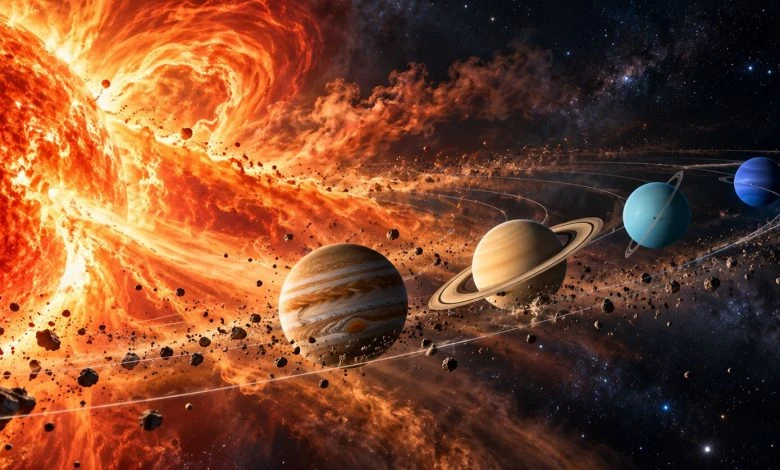
Computer modeling has shown that the Solar System may lose its current structure much earlier than previous calculations had suggested. The reason is the Sun’s uneven mass loss in the late stages of its life and the related gravitational disturbances capable of changing the orbits of the giant planets. The research findings were described by Sky & Telescope.
This does not mean Earth will disappear anytime soon: the scenario concerns the distant future, when the Sun passes through the red giant stage and turns into a white dwarf. The modeling does not predict an exact date for the Solar System’s demise, but shows how strongly its long-term stability depends on the details of stellar evolution.
How a dying Sun could change the planets’ orbits
As it ages, the Sun will lose mass. Because its gravitational pull weakens, planetary orbits will gradually expand. However, the loss of matter may occur unevenly: the star will eject it in separate bursts, creating additional disturbances in the planetary system.
In earlier models, mass loss was often represented as a smooth process. The new approach takes into account random impulses associated with matter ejections during the red giant stage. These can gradually alter the motion of the planets, especially in the outer part of the system, where Jupiter, Saturn, Uranus, and Neptune are located.
Even small orbital changes can eventually lead to complex consequences. For example, Jupiter and Saturn may enter an orbital resonance — a ratio of orbital periods in which the planets’ gravitational influence on each other is regularly amplified. But such a configuration does not necessarily stabilize the system: in some modeled scenarios, on the contrary, it is accompanied by more frequent orbital disruptions.
Why the planets could scatter
After the Sun sheds its outer layers and becomes a white dwarf, its gravity will be weaker than it is today. The expanded planetary orbits will become more vulnerable to disturbances, including those from stars passing relatively close to the Solar System.
Depending on the initial conditions and the sequence of gravitational interactions, the orbits may gradually become destabilized. Some planets may change their trajectories so dramatically that they are ejected from the system or begin interacting with each other at dangerously small distances.
According to the simulation results cited in the publication, in about 90% of the scenarios considered, the system lost its stable structure within three billion years. In 40% of cases, serious destabilization occurred even before the Sun completed the red giant stage and became a white dwarf.
These percentages describe the outcomes of computer scenarios, not the statistical probability of an event calculated from observations of real planetary systems. The result depends on the assumptions of the model and on which processes are included in it.
Why the new estimates differ from earlier ones
The gravitational interaction of several planets is a complex dynamical problem. Even if a system remains stable for billions of years, small changes in conditions can eventually lead to completely different outcomes. That is why forecasts for extremely long timescales are sensitive to the details of the model.
In earlier calculations, the long-term evolution of the Solar System could be considered on timescales of about (10^{18}) years — a billion billion years. New simulations indicate that after the Sun becomes a white dwarf, the system may lose stability much sooner, as early as the first billions of years of this stage.
However, the breakup of a planetary system does not mean that all planets will necessarily collide or be destroyed. It means the destruction of its current orbital configuration: some bodies may be ejected into interstellar space, while others may shift to new orbits.
The main conclusion of the study is not that the Solar System is doomed on a specific date, but that its distant future may turn out to be less stable than models with a simpler description of the Sun’s mass loss had suggested. To refine the forecast, scientists will need to assess how strongly the result depends on the physical properties of stellar ejections and other external disturbances.