make preferable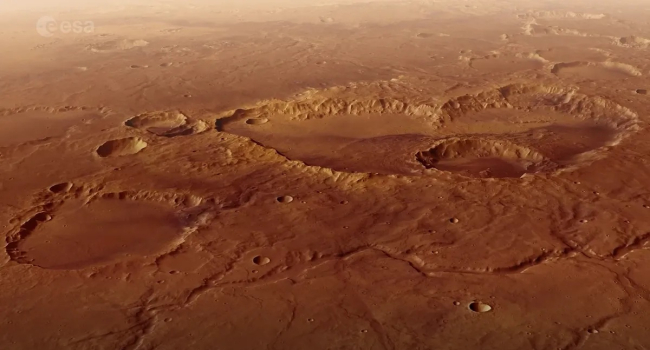
The European Mars Express orbiter has transmitted fresh, high‑detail images of one of Mars's most famous impact craters—Schiaparelli Crater. It was here, according to Andy Weir's novel and the film The Martian, that astronaut Mark Watney found himself stranded alone. The new images reveal not only the scale of the ancient impact basin but also traces of water that once flowed across the Red Planet's surface.
What Mars Express observed
The European Space Agency spacecraft, which has been orbiting Mars since 2003, passed at low altitude over the planet's southern highlands. On board is the High Resolution Stereo Camera, which simultaneously captures the terrain from multiple angles and in different spectral bands. This allows scientists to produce colour three‑dimensional surface models.
Schiaparelli Crater has a diameter of over 460 kilometres and ranks among the largest impact structures on Mars. Despite its enormous size, it is relatively shallow. Over billions of years, its floor has been filled with sediments deposited by wind and ancient water flows, as well as volcanic materials and debris from later impacts.
Traces of ancient water
The region containing the crater formed about 3.7 billion years ago, when Mars's climate was significantly warmer and wetter. Water actively reshaped the landscape, leaving behind channels and deposits. The new Mars Express data help scientists better understand exactly how these processes occurred within the impact basin.
Name, literature, and real history
The crater is named after the Italian astronomer Giovanni Schiaparelli (1835–1910). In 1877, during a great opposition of Mars, he produced a detailed map of the surface and noted dark lines, which he called "canali"—"channels." In translation to English, the word became "canals," sparking prolonged debates about the possible existence of intelligent life and artificial structures on Mars. The hypothesis was later refuted, but the astronomer's name remains on the planet's map.
Interestingly, in 2016, the European Space Agency sent a lander also named Schiaparelli to Mars. It crashed during landing, but its target was in a completely different region of the planet.
How such images are produced
Mars Express follows a highly elliptical orbit. During low‑altitude passes, the camera collects long strips of data—tens of kilometres wide and hundreds or even thousands of kilometres long. These strips are then stitched together into large regional maps that gradually build up the overall three‑dimensional model of Mars.
In brief
The Mars Express orbiter has captured new detailed images of Schiaparelli Crater—the site where, in the plot of The Martian, Mark Watney was stranded. The crater, over 460 km in diameter, lies in an ancient region shaped by water about 3.7 billion years ago. The images were taken by a high‑resolution stereo camera and help scientists better understand Mars's geological history. The crater was named after a 19th‑century Italian astronomer whose observations once gave rise to the legend of Martian canals.