make preferable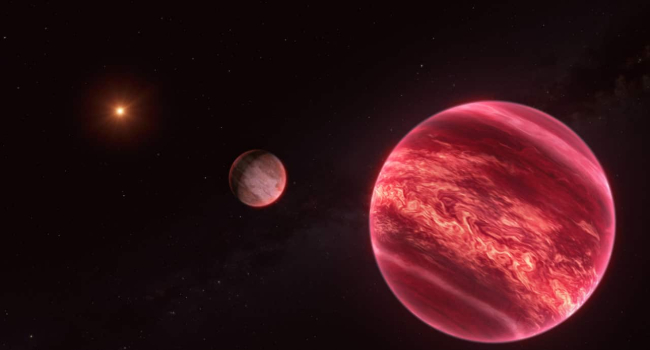
Scientists studying the system CD-35 2722, located 73 light-years from Earth, have detected an object that may turn out to be the first confirmed exomoon — or may force us to rethink the very concept of a "moon."
What exactly was found
The object orbits not a planet but a brown dwarf — a "failed star" that is more massive than the largest gas giants but not heavy enough to ignite nuclear fusion. The brown dwarf itself, in turn, orbits an ordinary star.
Lead researcher Kevin Haugh from the University of Diego Portales (Chile) noted that this system is rather difficult to describe in familiar Solar System terms like "planet" and "moon," adding that the detected object is clearly massive enough to be considered a planet, but it does not orbit a star, even though it orbits an object that orbits a star.
Why this matters
Until now, astronomers have not been able to reliably confirm the existence of any exomoon, although they should theoretically be common. This new finding is the first confident detection of an exosatellite, regardless of how it is ultimately classified.
What's next
Scientists hope that the Extremely Large Telescope (ELT), currently under construction in Chile, will significantly advance the search for exomoons and similar objects. For now, the discovery highlights just how diverse and unusual planetary systems beyond our own can be.
In brief
Astronomers have detected an object in the CD-35 2722 system (73 light-years from Earth) that may turn out to be the first exomoon. It orbits a brown dwarf rather than a planet. This is the first reliable detection of an exosatellite, although its exact classification remains an open question. The finding underscores the diversity of planetary systems in the Galaxy. The study was published in the journal Nature.