make preferable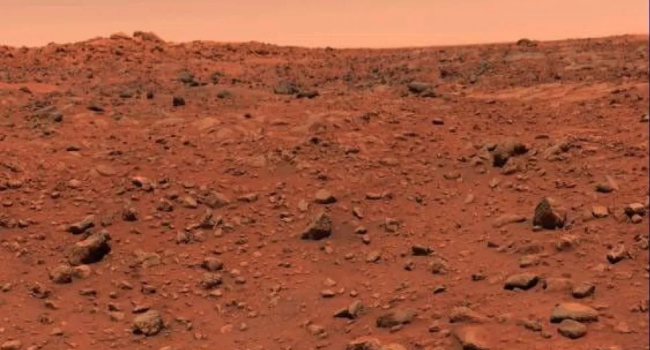
Exactly 50 years ago, on July 20, 1976, the Viking 1 lander touched down on the surface of Mars for the first time in history. Among the mission's main tasks was to answer a fundamental question: is there life on the Red Planet? Half a century later, scientists still have not reached a consensus, Space.com reports.
What the experiments showed
On board each Viking lander were three biological experiments, each using a different approach to searching for life. Two of them gave generally negative results. However, the third — the Labeled Release (LR) experiment, designed by Gilbert Levin — showed an unexpected positive response.
When nutrients were added to the Martian soil, the instrument detected the release of radioactive gas — a sign of metabolic activity in microorganisms. When nutrients were added a second time, there was no reaction. Many scientists took this as proof of the absence of life. However, Levin, until his death in 2021 at the age of 97, remained convinced that Viking had found microbial life on Mars — about 1,000 cells per gram of soil.
Why the results were interpreted differently
The main argument of those who opposed the biological interpretation came from the GCMS (gas chromatograph-mass spectrometer) instrument. It detected no organic molecules in the soil. However, critics note that the experiment used hydrogen but did not add it to the nutrient chambers. Furthermore, some minerals can produce a similar reaction, complicating any definitive conclusion.
Ben Clark, a member of the Viking science team, emphasizes that some types of terrestrial microorganisms use sulfates as an energy source. Unfortunately, Viking did not conduct the relevant tests.
Modern perspective
Today, some scientists believe that Viking could have detected life, but that the results were misinterpreted. Others point out that life on Mars could exist just a few centimeters below the surface, where ice is preserved.
Recent discoveries by rovers (organic molecules, "reduction spots") add weight to arguments for the existence of life in the past or present.
Preserving the Viking legacy
Rachel Tillman, founder of a non-profit project dedicated to preserving the legacy of the Viking missions, emphasizes the importance of archiving all data — both successful and unsuccessful experiments — to aid future generations of scientists and engineers.
Barry DiGregorio, an honorary research fellow at the UK Centre for Astrobiology, believes that the Viking data is even more important today than in 1976. However, he warns that contamination of Mars by terrestrial microorganisms over the past decades has made the search for native life more difficult.
In brief
Fifty years ago, the Viking missions conducted the first experiments to search for life on Mars. One of them (Labeled Release) gave a positive result, but most scientists interpreted it as a chemical reaction. The debate continues to this day: some researchers believe that Viking could have detected microbial life. New rover data and the re-evaluation of old results support this view. A full understanding may only come from future missions.