make preferable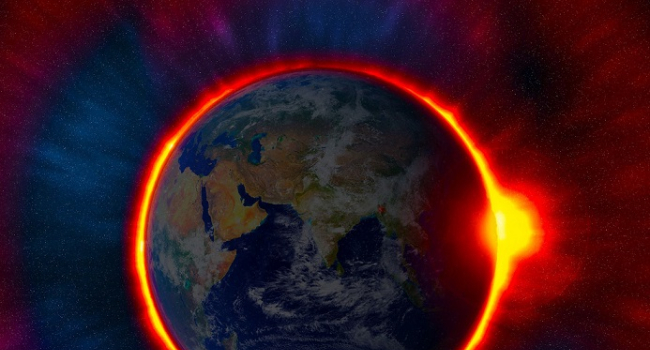
Scientists have revised the fate of our planet after the Sun turns into a red giant. According to a new study, Earth has a better chance of avoiding being swallowed by the star than previously thought.
How predictions have changed
Previously, many models predicted that in about 5 billion years, when the Sun exhausts its hydrogen core and expands greatly, it would engulf Mercury, Venus, and possibly Earth. However, a new study conducted under the leadership of Mats Esselders of KU Leuven (Belgium) uses more accurate calculations of the interaction between an expanding star and its planets.
The scientists took into account two competing processes:
- Tidal forces, which gradually "slow down" the planet and pull it closer to the star
- Mass loss by the Sun through powerful stellar wind, which weakens gravity and pushes planets farther away
What the modeling showed
According to the new calculations, Mercury and Venus will almost certainly be engulfed. However, Earth and Mars will most likely be able to move to a more distant orbit and survive both red giant phases. Ultimately, Earth could remain on a wider orbit around a white dwarf — what the Sun will eventually become.
Mats Esselders noted that the biggest uncertainty is now no longer tied to tidal interactions but to how much mass the future Sun will lose.
Important caveats
Although the new models lean toward Earth's survival, a definitive answer is not yet possible. Everything depends on the exact amount of mass the star will lose in the final stages of its evolution. Observations of similar stars (for example, L2 Pup) currently support the survival scenario.
However, even if Earth physically survives, life on it will most likely disappear much earlier — in about a billion years, when the Sun becomes significantly hotter and turns the planet into an uninhabitable desert.
Significance of the study
The work, published in June in the journal Astronomy & Astrophysics, helps better understand the evolution of planetary systems around aging stars. This is important not only for understanding the Solar System's future but also for assessing the habitability of exoplanets around other stars.
In brief
A new study suggests that Earth has a good chance of surviving the Sun's transformation into a red giant and remaining on a wider orbit around a future white dwarf. The main uncertainty now concerns how much mass the Sun will lose. Mercury and Venus will most likely be engulfed, while Earth and Mars will survive. Nevertheless, life on our planet is expected to disappear much earlier — in about a billion years — due to the gradual heating of the Sun. The work was published in the journal Astronomy & Astrophysics.