make preferable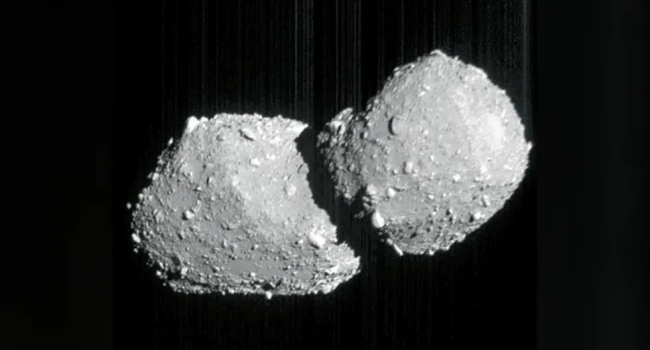
The Japan Aerospace Exploration Agency (JAXA) has released new unique images of asteroid Torifune, taken by the Hayabusa2 probe. The images were obtained during a high-speed flyby on July 5, 2026, at a distance of about 100 million kilometers from Earth.
What the probe revealed
In the optical images, asteroid Torifune (about 450 meters in diameter) appears in an unusual shape — with two prominent "heads." Additionally, Hayabusa2 captured mid-infrared images using the TIR camera. These allowed scientists to estimate the surface temperature: in shadowed areas, the asteroid is significantly cooler, while sunlit regions are noticeably warmer.
Torifune belongs to the Apollo group of asteroids — near-Earth objects whose orbits cross Earth's orbit. It orbits the Sun every 383 days and rotates around its axis roughly every 5 hours.
A risky but successful operation
The flyby of Torifune was not part of Hayabusa2's original mission plan. Scientists noted that it was a fairly risky operation due to limited data about the asteroid. Nevertheless, the probe successfully completed the task and transmitted the first images back to Earth.
Hayabusa2 mission history
The Hayabusa2 probe was launched in December 2014. The mission's main achievement was the delivery of samples from asteroid Ryugu to Earth in December 2020. Analysis of these samples allowed scientists to learn more about the early history of the Solar System and also to discover all five nucleobases that make up DNA and RNA.
After Ryugu, Hayabusa2 continued its journey. The probe's next target is the small asteroid 1998 KY26 (just 11 meters in diameter), which it is scheduled to reach in 2031. This could become the smallest asteroid ever visited by a spacecraft.
In brief
Japan's Hayabusa2 probe made a close flyby of asteroid Torifune on July 5, 2026, at a distance of 100 million kilometers from Earth. Stunning optical and infrared images of the unusual "two-headed" asteroid have been obtained. This was not part of the main mission plan but was successfully completed. Hayabusa2 continues its nearly 12-year expedition and is set to reach another small asteroid, 1998 KY26, in 2031. The mission has already yielded important scientific results, including samples from asteroid Ryugu.