make preferable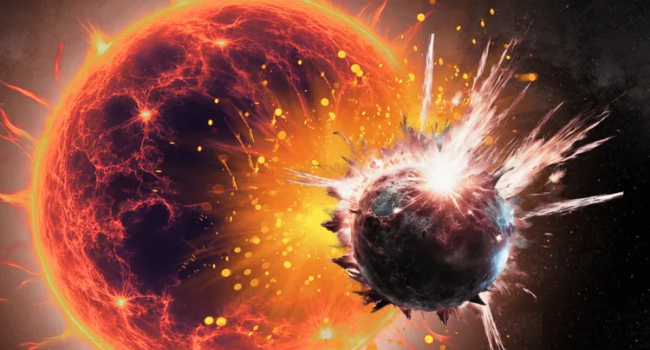
Astronomers are investigating a rare cosmic "crime": the star TOI-5882, located 1,300 light-years from Earth, appears to have consumed a super-Earth. The suspected accomplice is a brown dwarf that likely disrupted the planet's orbit and sent it straight into the star.
The mystery of elevated lithium content
The main clue was an unusually high lithium content in the star's atmosphere. Lithium in large quantities is characteristic of planetary material but is rare in stars.
Lead author of the study, Brooke Cotton from the University of Michigan, noted that you are what you eat, and scientists know that planetary material contains much more lithium than stars, so if a star swallows a planet, it receives a large portion of this element.
Planetary engulfment events happen very quickly — over a period of days or weeks — making them nearly impossible to catch in real time. Astronomers have to act as cosmic detectives, reconstructing the picture from indirect clues.
Why this is not a typical scenario
Normally, stars swallow their planets in the later stages of evolution, when they turn into red giants. At this point, they expand greatly and "engulf" nearby worlds. This is exactly how the Sun will swallow Mercury, Venus, and Earth in about 5 billion years.
However, TOI-5882 has not yet entered the red giant phase. This means the engulfment occurred under a different scenario. Scientists suspect that the star was "helped" by its companion — a brown dwarf.
A mysterious companion — a brown dwarf
Brown dwarfs are called "failed stars." They form like stars but do not accumulate enough mass to trigger nuclear reactions in their cores. This particular object has a mass of about 20 Jupiter masses (roughly 2% of the Sun's mass). This is enough to gravitationally influence the orbits of planets in the system.
The researchers suggest that the brown dwarf perturbed the super-Earth's orbit and sent it on a fatal trajectory toward the star. This mechanism still needs to be studied in more detail.
What the swallowed planet was like
By comparing TOI-5882's chemical composition with 62 similar stars of the same age and mass, scientists concluded that the swallowed planet was a super-Earth. Its mass ranged from 2 to 18 Earth masses (the upper limit corresponding to Neptune's mass).
Study co-author Seth Jacobson from Michigan State University explained that the lithium atoms delivered by the planet to the star are like fans arriving at a stadium — a few fans might have already been there (this being the initial lithium content in the star's atmosphere), but they quickly become the minority.
Melinda Soares-Furtado from the University of Wisconsin highlighted the precision of modern observations, noting that TOI-5882 is so enriched in lithium that it falls into at least the 97th percentile, adding that this is not data manipulation — the result is robust no matter how one looks at it.
Why this matters
Cases of planetary engulfment are relatively rare, and each such observation helps to better understand the dynamics of planetary systems and their evolution. For Soares-Furtado, this work is reminiscent of the detective investigation she dreamed of as a child.
The study was published on June 15, 2026, in The Astrophysical Journal.
In brief
The star TOI-5882, located 1,300 light-years away, shows anomalously high lithium content, indicating the recent engulfment of a super-Earth with a mass of 2 to 18 Earth masses. Unlike the typical red giant scenario, this case likely involved a brown dwarf of about 20 Jupiter masses that disrupted the planet's orbit. This rare event provides astronomers with valuable information about the fate of planets in binary systems and the evolution of stars.