make preferable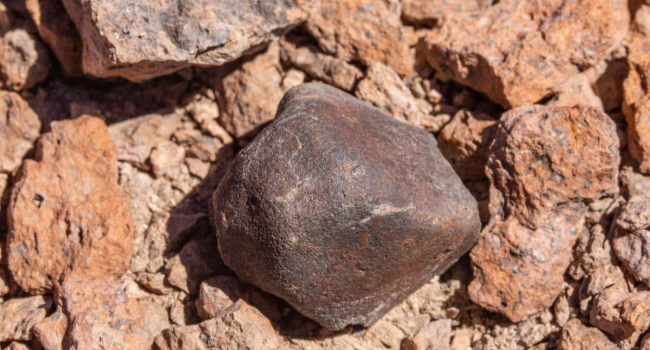
Scientists have discovered direct evidence of the existence of a large protoplanet that formed in the early Solar System along a completely different path than Earth or Mars. This discovery was made possible thanks to a rare meteorite, Northwest Africa (NWA) 12774, found in the Sahara.
Ancient angrites as a window into the past
The meteorite belongs to the group of angrites — among the oldest volcanic rocks in the Solar System. They formed just a few million years after the system's emergence 4.56 billion years ago. Of more than 80,000 known meteorites found on Earth, only 68 are angrites, making each such sample particularly valuable.
The study, conducted by scientists at the University of Colorado Boulder, was published in the journal Earth and Planetary Science Letters (EPSL).
The main clue — an unusual mineral
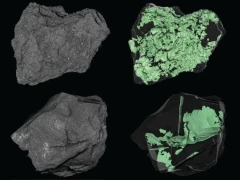
The key to the discovery was the mineral clinopyroxene with anomalously high aluminum content. Such a composition could only form under very high pressure — at least 17.5 kilobars. For comparison: at the bottom of the Mariana Trench, the pressure is about 1 kilobar.
Such conditions are only possible in the crust or mantle of a sufficiently large celestial body. Calculations showed that the minimum radius of the parent planet was about 1,000 kilometers.
Additional crystal analysis confirmed even larger dimensions. The crystals preserved sharp edges and fine chemical details that would inevitably have been destroyed if they had been deep inside a giant planet. This indicates they formed relatively close to the surface. Ultimately, scientists estimate the protoplanet's radius at approximately 1,800 km — the size of the Moon.
A planet with a different "recipe"
Most interestingly, the chemical composition of this protoplanet was fundamentally different from Earth's. It almost completely lacked silicon dioxide — the main component of most rocks on Earth and Mars.
Lead author of the study Aaron Bell noted that this indicates a separate and independent evolutionary path in planet formation at the dawn of the Solar System.
Apparently, this protoplanet was either destroyed as a result of powerful collisions in the early Solar System, or its debris scattered, becoming the source of angrite meteorites.
Why this matters
The discovery shows that not only the familiar planets formed in the early Solar System, but also bodies with completely different compositions and histories. The study of such "lost" worlds helps to better understand exactly how planets were born 4.5 billion years ago and why our Solar System looks the way it does and not otherwise.
In brief
In the NWA 12774 meteorite from the Sahara, scientists found traces of a vanished protoplanet the size of the Moon (with a radius of up to 1,800 km). It formed from material with a very low silicon dioxide content, fundamentally different from the composition of Earth and Mars. This is the first direct evidence of the existence of a large body that evolved along a separate evolutionary path at the dawn of the Solar System. The study was published in the journal Earth and Planetary Science Letters.