make preferable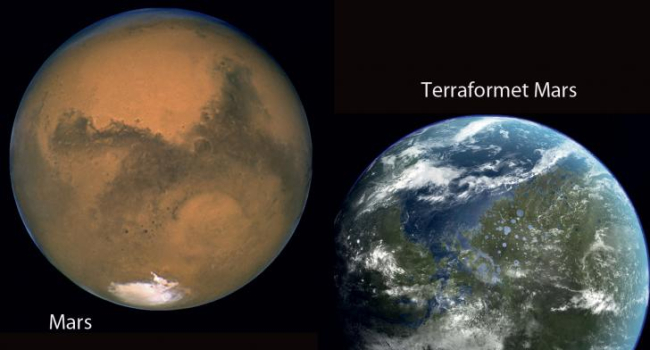
Scientists are actively studying the possibility of terraforming Mars — transforming the cold and inhospitable planet into a more welcoming world. One proposed approach is spraying a special aerosol to gradually warm the atmosphere. This could be the first step toward creating conditions suitable for Earth-based life forms.
Research roadmap
Edwin Kite, associate professor of geophysical sciences at the University of Chicago, presented a detailed research plan at the Space Resources Roundtable in Colorado. According to him, the goal is not to prove that terraforming is necessary but to objectively assess what it would require, how much it would cost, and what risks it entails.
Kite noted that creating sustainable habitats and biospheres beyond Earth is a huge scientific and technical challenge, but one that will have to be overcome if we want to extend life beyond our planet.
He emphasized that relatively modest investments in research would preserve the possibility of expanding life beyond Earth as scientific exploration of Mars continues.
Potential technologies
Among the methods under consideration is the use of solid-state greenhouse membranes, which could yield near-term practical results for extracting moisture and sustaining life at bases. Enhancing Mars's natural greenhouse effect could warm significant regions of the planet, though many details still need to be worked out.
Kite and his colleagues are also studying the concept of a demonstration mission: a small automated module that would spray less than 1 kg of submicron artificial particles and track their dispersal using a laser at an altitude of about 500 meters. The technology would first be tested on Earth in the unique NASA Planetary Aeolian Laboratory, which simulates Martian conditions.
Unknown factors
Scientists acknowledge that there is currently insufficient data to determine whether Mars could sustain a biosphere. More accurate maps of subsurface water ice, climate orbiters, the return of Martian soil samples to Earth, and international cooperation are all needed.
Kite expressed hope that China, through the Tianwen-3 mission, would share samples collected from different regions of the planet. He also mentioned the International Mars Ice Mapper project, which could significantly improve understanding of Mars's water reserves.
A long road ahead
If early aerosol experiments are successful, they could form the basis for larger-scale government programs. However, even in an optimistic scenario, warming on a kilometer scale would take at least a decade, and large-scale environmental change would require decades of sustained investment.
In brief
Scientists are developing a research roadmap to determine whether terraforming Mars is possible. One of the first steps would be spraying aerosol to warm the atmosphere. The project does not necessarily commit to carrying out terraforming but merely keeps the option open. Implementation would require decades of work, significant investment, and international cooperation. For now, the primary task is to gather missing data on the Red Planet's water, climate, and geology.