make preferable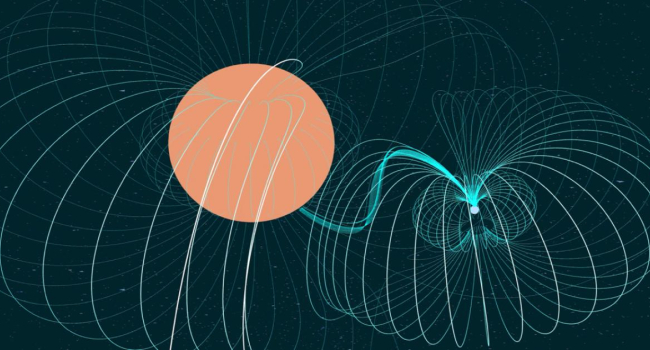
most unusual types of cosmic signals discovered in recent years: long-period radio transients. The findings were published in the journal Nature Astronomy.
A Mystery That Lasted for Years
These objects first attracted attention in 2022 when astronomers discovered a source emitting powerful radio bursts every 18 minutes. Such behavior did not match any known class of astronomical object. Since then, several similar sources have been identified, but their origin remained a mystery.
The breakthrough came with an object known as ASKAP J1745-5051. It emits radio bursts every 81 minutes. X-ray flashes occurring on the same schedule were also detected by NASA’s Neil Gehrels Swift Observatory and the Chinese-led Einstein Probe.
What the Scientists Found
Observations revealed that the source is a close binary star system consisting of a white dwarf and a red dwarf.
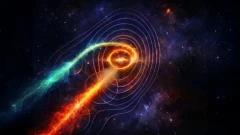
The white dwarf possesses a powerful magnetic field and gradually pulls matter away from its companion star. As this material falls onto the white dwarf’s surface, it is heated to millions of degrees, producing X-ray radiation. According to the researchers, the radio bursts are generated by interactions between the intense magnetic fields of the two stars, which accelerate charged particles.
We are seeing, for the first time, a system where both stars and the accretion process itself are visible simultaneously, said co-author Tara Murphy of the OzGrav research center.
Why the Discovery Matters
ASKAP J1745-5051 combines several features that had previously been observed separately in different long-period radio transients: periodic radio bursts, X-ray emission, strong magnetic fields, and active mass transfer between stars.
While not all such objects are necessarily produced by the same mechanism, the new discovery suggests that a significant fraction of these mysterious signals may originate from rare magnetic binary systems containing white dwarfs.
We are only beginning to understand this new class of cosmic phenomena, Kovi Rose emphasized.
In Brief
Astronomers have identified the nature of long-period radio transients for the first time. One such object turned out to be a binary system in which a white dwarf actively accretes matter from a red dwarf companion. The system produces both radio and X-ray bursts every 81 minutes. The discovery helps explain a series of mysterious periodic signals detected in recent years and points to a previously unrecognized class of astronomical objects.