make preferable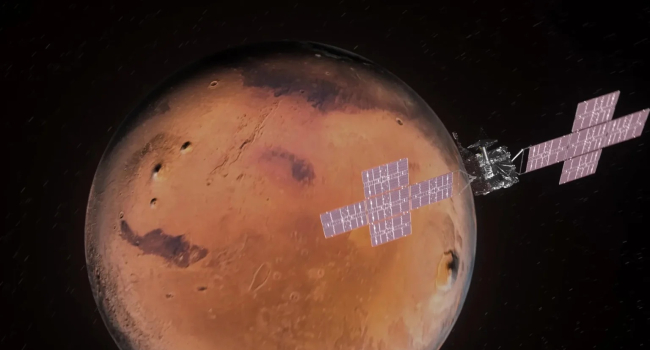
Today, May 15, NASA’s Psyche spacecraft will perform a close gravity-assist maneuver near Mars. The flyby marks a major milestone in the probe’s long journey toward the metal-rich asteroid after which the mission is named.
The spacecraft will pass the Red Planet at a distance of about 2,800 miles (4,500 km), using Mars’s gravity to accelerate and refine its trajectory.
Why the Mars flyby matters
As reported by Space.com, the primary purpose of the maneuver is a gravity assist. The spacecraft is currently traveling at around 12,333 mph (19,848 km/h). Mars’s gravitational pull will give the probe additional speed and redirect its course toward the Main Asteroid Belt, where the mission’s destination—16 Psyche—is located.
NASA explained that the sole purpose of the flyby is to receive a small boost from Mars in order to gain speed and turn toward the asteroid Psyche.
The spacecraft was launched in October 2023. Without the gravity-assist maneuver, the mission would have consumed significantly more xenon fuel. By using the flyby, the spacecraft conserves valuable resources and remains on track to reach the asteroid in 2029.
What the spacecraft will do near Mars
The flyby is not only a navigational maneuver but also an important opportunity to test and calibrate the mission’s scientific instruments before operations begin at the asteroid itself.
The spacecraft’s multispectral imager already began photographing Mars in early May and is expected to capture thousands of images. This marks the instrument’s first major calibration using a large planetary object rather than only a few pixels of distant light.
Sarah Barstow, mission planning lead at NASA’s Jet Propulsion Laboratory, said the team successfully placed the spacecraft on the correct trajectory and programmed the onboard computer for all operations throughout May. She added that this would be the mission’s first in-flight opportunity to calibrate Psyche’s camera on something larger than a few pixels and to conduct observations using the spacecraft’s other scientific instruments.
The mission team also hopes to:
- detect a faint dust torus around Mars, potentially formed by material blasted off Phobos and Deimos by micrometeorite impacts
- search for small undiscovered Martian moons as practice for identifying tiny “moonlets” around asteroid Psyche itself
Why asteroid Psyche is so valuable
The asteroid 16 Psyche, which measures about 280 km in diameter, is considered one of the most unusual objects in the Solar System. Scientists believe it may be the exposed iron-nickel core of an ancient planetesimal—a planetary building block whose outer rocky layers were stripped away in violent collisions.
Studying such an object could provide rare insight into the internal structure of Earth and other rocky planets.
In brief
On May 15, 2026, NASA’s Psyche spacecraft will make a close flyby of Mars at a distance of roughly 4,500 km. The gravity-assist maneuver will accelerate the probe and redirect it toward asteroid Psyche, which it is scheduled to reach in 2029. At the same time, the mission will test and calibrate its scientific instruments, capture thousands of images of Mars, and attempt to detect both a faint dust ring and small undiscovered moons around the planet. The flyby represents an important preparatory step before the mission’s primary scientific phase begins.