make preferable
A new international study has challenged long-standing assumptions about some of the earliest evidence of animal life on Earth. Structures once thought to be traces of primitive animals may, in fact, be something far more ordinary — ancient microbial colonies.
The research, published in Gondwana Research, re-examines geological samples dating back roughly 540 million years.
What Were Once Thought to Be Early Animal Traces
The debate centers on rock formations from the Tamengo Formation in Mato Grosso do Sul, Brazil.
Earlier studies suggested that microscopic markings found in these rocks could represent traces left by simple worm-like organisms living on the seafloor during the Ediacaran period — a time just before the Cambrian explosion, when complex animal life rapidly diversified.
These markings were interpreted as possible movement trails, implying that early animals were already active on the ocean floor much earlier than many scientists expected.
A Very Different Explanation: Microbial Communities
New analyses, however, paint a different picture.
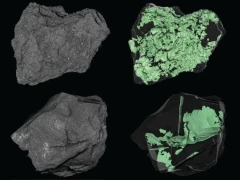
Researchers led by Bruno Becker-Kerber used advanced imaging techniques, including synchrotron microtomography at the Sirius accelerator facility and Raman spectroscopy, to study the samples in unprecedented detail.
Their conclusion was that the structures show clear signs of cellular organization and preserved organic material consistent with microbial life — not animals.
According to the researchers, the formations are best explained as colonies of bacteria and algae that once thrived in ancient marine environments.
Some appear to be linked to sulfur-oxidizing bacteria, while others resemble ancient cyanobacteria and different types of algae. The diversity in size and structure also suggests organized microbial communities rather than traces of animal movement.
Why This Changes the Evolutionary Timeline
If correct, the findings could reshape how scientists understand the early evolution of complex life.
The study challenges the idea that animals were already widespread in the Ediacaran seas. Instead, it suggests that microbial ecosystems may have dominated these environments for longer than previously thought.
One possible explanation is that oxygen levels in ancient oceans were still too low to support most animal life at the time. This aligns with geochemical evidence suggesting that a significant rise in oxygen occurred closer to the Cambrian explosion.
In Brief
Scientists studying 540-million-year-old rocks from Brazil have concluded that structures once thought to be traces of early animals are actually fossilized microbial colonies.
Using high-resolution imaging and spectroscopy, researchers identified cellular structures consistent with bacteria and algae. The findings suggest that complex animal life may have appeared later than previously believed and reinforce the idea that low oxygen levels played a key role in delaying early animal evolution.