make preferable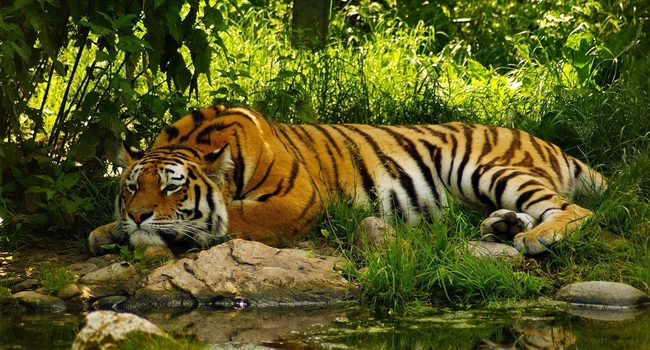
Scientists used an online game involving over 1,000 participants to discover why tigers evolved their distinctive stripes—and the answer is linked to sunlight. The study, conducted by researchers from the Universities of Exeter and Bristol, showed that high-contrast patterns like tiger stripes are harder to detect in bright sunlight and complex 3D environments, such as tall grass and forest thickets. Conversely, more uniform coloration provides better camouflage in overcast weather and open spaces with low vegetation.
How the Game Works
In the game developed by University of Exeter scientists, a patterned sphere "evolved" over 20 generations, becoming increasingly difficult to spot against realistic natural landscapes. Players searched for the spheres, and if one took longer to find, the game used that information to create the next generation of patterns by combining pairs of the most "successful" ones. "In essence, digital evolution in our study helped us better understand real-world evolution," said Dr. George Hancock from the Centre for Ecology and Conservation at Exeter’s Penryn Campus in Cornwall. The backgrounds used in the game were taken from photographs of 28 habitats of varying complexity across the UK, each captured under both direct and diffused sunlight.
Sunlight, Shadows, and Stripes
Under direct sunlight, high-contrast dark striped patterns emerged on the spheres, along with countershading—lighter underbellies typical of tigers, antelopes, and great white sharks—and disruptive coloration, which breaks up the animal's outline. "When the sun comes out, shadows make the background environment more visually complex and directional," said Dr. Hancock. "Shadows become sharper and even more directional when the environment is more three-dimensional—for example, in thickets of tall vegetation. This is exactly how tigers got their stripes: they mimic the striped shadows characteristic of their habitat." Researchers also noted that many predators are most active at dawn and dusk, when long shadows create additional visual complexity, making striped and high-contrast camouflage even more effective.
Implications for Conservation
The findings, published in the journal PLOS One, have implications beyond evolutionary biology. Scientists warned that changes in habitat and lighting conditions—caused by land development, urbanization, and climate change—could reduce the effectiveness of camouflage strategies that species have developed over millennia. "It is crucial to understand how such changes might affect animal survival—especially for species that are already endangered," stated Dr. Jolyon Troscianko from the University of Exeter.