make preferable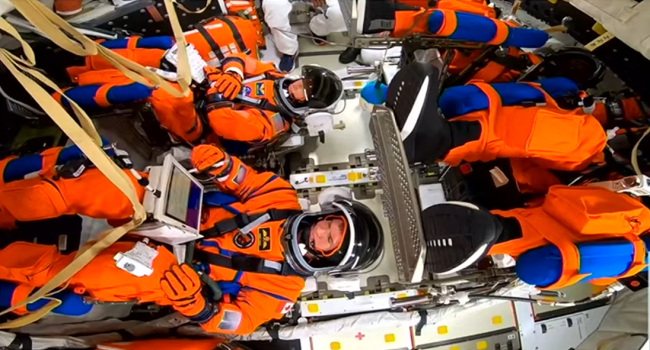
The Orion spacecraft has successfully completed the mission’s key maneuver—the translunar injection (TLI). As a result, Artemis II is now truly on its way to the Moon.
On the evening of April 2, 2026, roughly a day after launch, the crew fired Orion’s main engine for five minutes and fifty seconds. This brief but crucial burn sent the spacecraft from Earth orbit onto a free-return trajectory around the Moon. Following this maneuver, no major course corrections are expected to be necessary, as the engine serves both to accelerate the spacecraft toward the Moon and to enable its eventual return to Earth.
Shortly after the maneuver, Canadian Space Agency astronaut Jeremy Hansen reported that the crew was feeling well on their way to the Moon and wanted to let everyone on Earth who had worked to make Artemis possible know that they had strongly felt the power of that collective effort during every second of the burn. He added that humanity had once again demonstrated what it is capable of, and that the hopes for the future carried by people on Earth were now propelling the crew on their journey around the Moon.
The First Day of Flight
Artemis II launched on the evening of April 1, 2026, from Kennedy Space Center in Florida. This marks the first crewed flight of the Space Launch System (SLS) and the Orion spacecraft. The crew consists of four astronauts: commander Reid Wiseman, pilot Victor Glover, mission specialist Christina Koch (all from NASA), and Jeremy Hansen (CSA).
The first 24 hours were spent in Earth orbit, with the crew carefully checking all spacecraft systems. Only after the ground team confirmed full readiness was approval given for the main maneuver.
Technical Details of the Burn
The translunar injection was carried out using the main orbital maneuvering engine, originally developed for the Space Shuttle program. This engine has flown 19 times in space aboard three different shuttles and has since been upgraded for lunar missions. Engineers noted that, if installed in a car, it would be capable of accelerating it from 0 to 97 km/h in just 2.7 seconds.
Orion is equipped with three primary propulsion systems: the main engine, eight auxiliary thrusters on the European Service Module, and smaller reaction control thrusters on the capsule itself.
Historical Significance of the Mission
Artemis II will be the first crewed mission to lunar vicinity since December 1972, when Apollo 17 concluded. For humanity, it represents both a symbolic and technological milestone after more than half a century.
The composition of the crew is particularly notable. Christina Koch has become the first woman to travel beyond low Earth orbit. Victor Glover is the first Black astronaut to head toward the Moon. Jeremy Hansen is the first non-American astronaut to take part in such a mission.
On the sixth day of the mission, Orion will fly around the Moon, and the crew is expected to set a new distance record, traveling farther from Earth than any humans before them. The previous record was set by the Apollo 13 crew in 1970, when they reached a maximum distance of 400,171 kilometers from Earth due to an in-flight emergency.
The return to Earth is scheduled for the tenth day of the mission, with the capsule set to splash down in the Pacific Ocean near San Diego.
What’s Next for the Artemis Program
The successful completion of Artemis II will mark a major step toward returning humans to the lunar surface. The next key milestone is Artemis IV, which, according to current plans, is expected to deliver astronauts to the Moon in 2028. This will be followed by the construction of a long-term lunar base.
In Brief
Artemis II has successfully completed its most critical phase—the translunar injection. After a five-minute engine burn, the Orion spacecraft left Earth orbit and set course for the Moon. The crew—Reid Wiseman, Victor Glover, Christina Koch, and Jeremy Hansen—will become the first humans to travel to lunar vicinity in over 50 years. The mission will last 10 days, set a new distance record from Earth, and pave the way for a crewed lunar landing as part of Artemis IV in 2028.