make preferable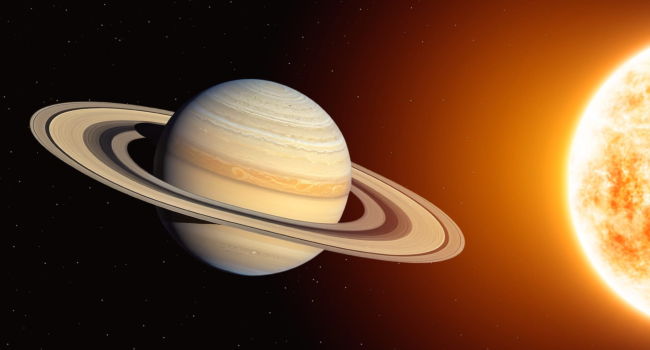
A new study based on data from the Cassini spacecraft has shown that Saturn’s magnetosphere differs significantly from the nearly symmetrical “magnetic shell” of Earth. It is noticeably skewed, and the main causes appear to be the planet’s extremely rapid rotation and the activity of its icy moon Enceladus.
Scientists analyzed six years of Cassini observations (2004–2010), focusing on the so-called magnetic cusp—the region where Saturn’s magnetic field lines begin to bend back toward the poles and direct charged particles into the planet’s atmosphere, according to Space.com.
They found that Saturn’s cusp is shifted to the right when viewed from the Sun. On Earth, it is located roughly at “12 o’clock” (directly facing the Sun), whereas on Saturn it most often lies between “1 and 3 o’clock.” This is a stable asymmetry that had not previously been measured with such precision.
Why Saturn’s Field Is “Skewed”
Saturn is the second-largest planet in the Solar System, and its magnetosphere is enormous—about ten times wider than the planet itself. A day on Saturn lasts just 10.7 hours, meaning it rotates extremely quickly. During this rotation, it drags along a heavy “plasma soup”—ionized gas that enters the magnetosphere primarily from its moons.
The main source of this plasma is Enceladus, famous for its icy geysers that eject water vapor from a subsurface ocean. This vapor becomes ionized and significantly “loads” the magnetosphere with mass. Saturn’s rapid rotation pulls this heavy plasma along, leading to a shift in magnetic field lines and the overall structure of the cusp.
One of the study’s co-authors, Andrew Coates, noted that the research provides important confirmation of a long-standing theory: for massive, rapidly rotating planets with active moons, the dominant factor shaping the magnetosphere is not the solar wind, but the planet’s own rotation and internal processes.
Why This Matters Now
Understanding Saturn’s magnetic environment is especially relevant now, as the scientific community is actively discussing plans to return to the Saturn system—particularly to Enceladus, one of the most promising places in the Solar System in the search for life.
Andrew Coates explained that a better understanding of Saturn’s environment is urgently needed as plans for returning to Saturn and Enceladus are being developed, adding that these results increase excitement about going back, this time to search for evidence of habitability and possible signs of life.
Enceladus is of particular interest because beneath its thick icy crust lies a global ocean of liquid water, and its geysers regularly eject material from this ocean into space. Studying how the magnetosphere interacts with these plumes will help better plan future missions and determine how well this ocean is protected from—or exposed to—cosmic radiation.
Comparison with Earth and Jupiter
The study’s lead author, Zhonghua Yao, emphasized that the differences between the magnetospheres of Saturn and Earth point to a shared fundamental physics governing how the solar wind interacts with planets. At the same time, Saturn’s magnetosphere is, in many respects, closer to that of Jupiter than to Earth’s.
The data were obtained using two key Cassini instruments: the magnetometer (MAG) and the plasma spectrometer (CAPS). Scientists recorded 67 crossings of the magnetic cusp and used these observations to model the shape of the magnetic field.
The study was published on April 1, 2026, in the journal Nature Communications.
In Brief
Saturn’s magnetic field is asymmetrical, with its magnetic cusp shifted to the right relative to the direction of the Sun. This is caused by the planet’s rapid rotation (a 10.7-hour day) and the large amounts of plasma supplied by its moon Enceladus through icy geysers. The discovery is important not only for understanding gas giants, but also for preparing future missions to Enceladus—one of the leading candidates in the search for extraterrestrial life in the Solar System.