make preferable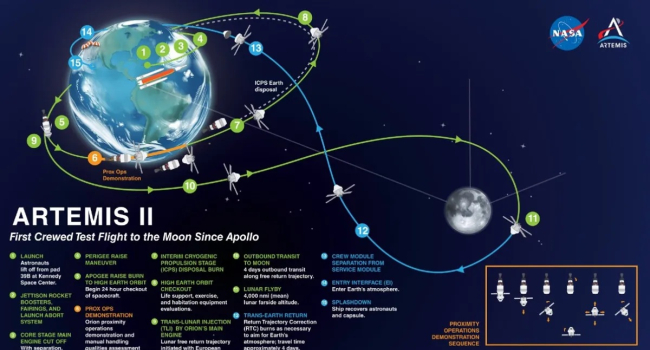
The Artemis 2 mission appears truly ambitious: four people will embark on a ten-day journey around the Moon and back to Earth. However, there will be no landing on the surface. This is not a planning mistake, but a deliberate stage of the program designed to ensure that everything works properly with a crew in real deep-space conditions.
Who Will Fly and Why It Matters
The mission will be commanded by NASA astronaut Reid Wiseman, with Victor Glover as pilot, Christina Koch as mission specialist, and Canadian Jeremy Hansen from the CSA as the fourth crew member.
Glover will become the first Black astronaut to travel to the Moon, Koch the first woman, and Hansen the first non-American to take part in such a mission. For humanity, this will mark the first return to lunar vicinity since 1972, when the Apollo 17 mission concluded.
Why a Flyby Instead of a Landing
The Orion spacecraft that will carry the astronauts is simply not designed to land on the Moon—it has no landing legs or the necessary systems. NASA is following a proven approach: first test everything without humans, then with humans but without a landing, and only afterward proceed to a full landing.
Artemis 1 successfully flew around the Moon without a crew at the end of 2022—this was the first flight of the super-heavy SLS rocket. Before that, Orion flew once around Earth in 2014 on a Delta IV rocket.
Artemis 2 will be the first crewed mission to the Moon. For the first time, all life-support systems will be activated on board, and the crew will test how to control the capsule in Earth orbit before executing the decisive burn toward the Moon.
NASA explains that the mission is intended to confirm that all spacecraft systems function exactly as designed with a crew on board under real deep-space conditions. It further states that the mission will pave the way for lunar surface landings, establish a foundation for long-term science and exploration, and inspire the next generation of explorers.
How Plans Changed: From 2024 to 2028
Initially, in 2019, the White House under President Trump set a goal of returning Americans to the Moon by 2024. The timeline proved highly ambitious—too ambitious, in fact. By 2021, NASA’s Inspector General acknowledged that delays with the new xEMU spacesuits made this impossible. NASA later shifted to a commercial solution from Axiom Space.
By 2027, Artemis 3 had been planned as the first landing mission. However, in late February 2026, the program was significantly restructured. Artemis 3 will now become a rehearsal for docking and rendezvous in Earth orbit between Orion and one or both private lunar landers—Starship from SpaceX and Blue Moon from Blue Origin. If successful, Artemis 4 in 2028 will finally deliver humans to the lunar surface.
The main long-term goal of Artemis is not merely to “touch the Moon,” but to establish a sustainable base and demonstrate American rules of engagement in lunar space through the Artemis Accords. It is both a scientific program and an element of competition with China.
The Program’s Main Bottlenecks
Delays have not been caused by spacesuits alone. The two most serious issues are the lunar landing system and Orion’s heat shield.
Lunar Lander: Starship in the Spotlight
In 2021, NASA awarded the lunar lander contract to SpaceX—Starship was valued at $2.9 billion without a competition. Blue Origin and Dynetics protested but lost. Later, the Senate required NASA to select a second contractor—Blue Origin received a $3.4 billion contract, with its landings planned for Artemis 5.
Starship has had a challenging development path. Its first fully assembled flight in April 2023 ended in failure. In 2025, SpaceX conducted five test flights. The last two, in August and October, were deemed fully successful: the Ship upper stage returned safely after a suborbital flight and splashed down off the western coast of Australia, while the Super Heavy booster performed a precise landing in the Gulf of Mexico.
Nevertheless, in October 2025, acting NASA Administrator Sean Duffy publicly stated that he admired SpaceX as an outstanding company but noted that they were behind schedule, had shifted their timelines, and that the United States was in a race with China.
A few days later, SpaceX proposed a simplified Artemis 3 architecture to accelerate progress. In early 2026, Elon Musk further intensified the company’s focus on lunar efforts, even suggesting the long-term possibility of building an entire city on the Moon. Blue Origin, for its part, paused its New Shepard program for at least two years to concentrate fully on its lunar project.
Orion Heat Shield Issue
Artemis 1 completed its primary objectives, but after returning in 2022, it became clear that the heat shield had lost more material than expected. In May 2024, a report from NASA’s Inspector General identified more than 100 areas with anomalous ablation, as well as issues with separation bolts and the power system.
In December 2024, NASA postponed Artemis 2 to 2026 and Artemis 3 to 2027. The heat shield was not replaced; instead, a gentler reentry profile was selected for Artemis 2. The agency remains confident that the crew will be safe.
What Comes Next: Artemis 3 and 4
After Artemis 2, its results will immediately feed into preparations for the next missions. NASA currently plans Artemis 3 for 2027 and Artemis 4 for 2028. Both missions will require at least one of the two lunar landers to be ready.
An internal SpaceX document obtained by Politico in November 2025 points to September 2028 as the target date for the first crewed landing. To achieve this, the company must complete two key milestones: the first orbital refueling demonstration in June 2026 and an uncrewed Starship landing on the Moon in June 2027.
In December 2025, a new executive order from the Trump administration formally confirmed the goal of returning Americans to the Moon by 2028 through the Artemis program.
In an interview with Aerospace America on February 10, 2026, new NASA Administrator Jared Isaacman emphasized that he wanted to carry out a crewed landing as soon as possible, but identified successful orbital refueling as the key requirement. He also introduced new internal directives intended to accelerate progress and, if necessary, increase the number of civil service positions within the agency.
In Brief
Artemis 2 is not a mission for its own sake, but a critical testing phase. Four astronauts will fly around the Moon, test Orion with a crew in deep space, and return. The landing has been postponed to Artemis 4 (2028) because the spacecraft is not designed for it and the program follows a step-by-step approach. The main challenges are the development of Starship, the heat shield, and the need to demonstrate orbital refueling. Despite all the delays, Artemis remains the most significant American lunar program since Apollo, and 2028 now appears to be a realistic target for humanity’s next steps on the Moon.