make preferable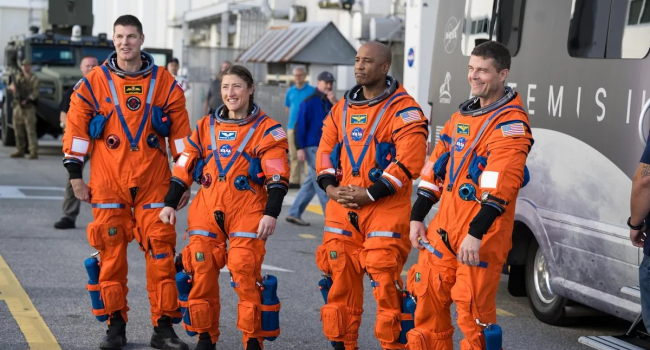
The Artemis 2 mission, scheduled for launch on April 1, 2026, will be the first crewed NASA flight beyond low Earth orbit since 1972. Four astronauts aboard the Orion spacecraft will spend 10 days in space, traveling far beyond Earth’s protective magnetic field. Under these conditions, space weather — solar flares, coronal mass ejections, and galactic cosmic rays — becomes a serious risk factor.
Why Radiation Is Dangerous Beyond Earth’s Magnetosphere
Earth’s atmosphere and magnetic field reliably protect us from most solar radiation and charged particles. However, during a flight to the Moon, astronauts become much more vulnerable. Solar flares, and especially powerful coronal mass ejections (CMEs), can create dangerous radiation levels. Galactic cosmic rays, arriving from deep space, pose an equally serious threat.
How NASA and NOAA Are Preparing for the Mission
To ensure crew safety, NASA is working closely with the National Oceanic and Atmospheric Administration (NOAA) and its Space Weather Prediction Center (SWPC).
Two SWPC specialists will be present in Mission Control in Houston throughout the mission, working side by side with NASA radiation safety experts (SRAG).
Core forecasts will be prepared in Boulder, Colorado, but on-site operational support will allow near-instant decision-making.
In the event of a Solar Energetic Proton Event (SPE), astronauts may receive protective guidance.
Sean Dahl, SWPC service coordinator, stated that they are fully prepared to support the Artemis 2 mission. At the same time, he noted that it is currently impossible to accurately predict solar activity during the flight, although we are in the declining phase after the solar maximum.
Drills and Readiness Level
In April–May 2025, a major exercise was conducted involving more than 70 specialists from NASA, the U.S. Air Force, commercial companies, and research institutions. Participants simulated a powerful radiation storm, tested forecasting models, and refined coordination between different teams.
Jamie Favors, director of NASA’s space weather program in the heliophysics division, stated that from a space weather perspective, they currently feel cautiously confident.
According to him, both forecasting models and communication between all involved groups have significantly improved in recent years. During the mission, multiple models will be used — similar to hurricane forecasting on Earth. Teams from SWPC, SRAG, and the Moon to Mars Space Weather Analysis Office will operate around the clock, providing both “all clear” updates and real-time warnings of hazardous events.
In Brief
Yes, space weather poses a real threat to Artemis 2 astronauts, as the Orion spacecraft will travel far beyond Earth’s protective magnetic field. However, NASA and NOAA have prepared extensively: during the 10-day mission, continuous monitoring and forecasting will be in place, with specialists working directly in Mission Control. While risks cannot be completely eliminated, the current level of readiness is considered high. The mission will serve as an important test of safety systems ahead of future lunar expeditions and missions to Mars.