make preferable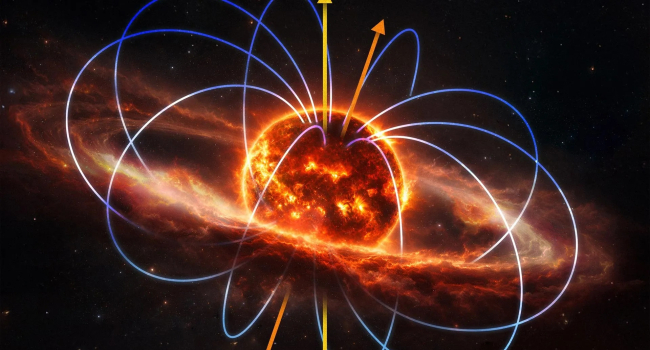
An international team of astronomers has proposed an original way to study “space weather” around other stars — a factor that can decisively influence planetary habitability. Instead of trying to directly measure invisible particle streams, scientists have learned to use the stars themselves as natural sensors. The study was published in The Astrophysical Journal Letters (AJL).
The Problem of Red Dwarfs
Red dwarfs are the most common stars in the Universe. They are smaller and cooler than the Sun, but many of them are surrounded by rocky planets roughly the size of Earth. However, such systems have long been considered poorly suited for life due to frequent powerful flares and intense stellar winds — streams of charged particles that can strip away planetary atmospheres.
Astronomer Luke Bouma of the Carnegie Institution explained that a star’s influence on its planets is determined not only by its light, but also by magnetic storms and stellar wind, and that these processes are especially difficult to observe over vast distances.
An Unexpected Solution: The Star as a Sensor
Scientists turned their attention to a rare type of young, rapidly rotating red dwarfs that periodically show characteristic drops in brightness. Previously, astronomers had explained these fluctuations by the presence of large dark spots on the star’s surface. The new study showed that the cause is different.
Using “spectroscopic movies” (a detailed analysis of changes in the spectrum over time), the team discovered clouds of plasma around these stars, held in place by powerful magnetic fields. These clouds form a torus-shaped structure — a kind of plasma ring encircling the star.
Luke Bouma noted that these brightness fluctuations were no longer a mystery but had become a tool, and that the plasma torus reveals where matter is located, how it moves, and how it is affected by the star’s magnetic field.
A New Tool for Studying Space Weather
According to the researchers, such plasma tori may exist around roughly 10% of young red dwarfs. This opens up a fundamentally new way to remotely study space weather around other stars without the need for direct measurements of stellar wind.
Observing the motion and behavior of these plasma structures makes it possible to indirectly estimate the strength of a star’s magnetic field, the intensity of particle emissions, and the overall “aggressiveness” of its surrounding environment.
The next important step will be to determine the origin of the plasma: whether it is generated by the star’s own activity or comes from the surrounding space. The answer to this question will help clarify how dangerous space weather around red dwarfs is for potentially habitable planets.
In Brief
Astronomers have proposed using plasma tori around young, rapidly rotating red dwarfs as natural “space weather stations.” These structures, which cause periodic drops in stellar brightness, make it possible to study magnetic activity and streams of charged particles that affect planetary habitability. It is estimated that such plasma rings occur around about 10% of young red dwarfs. The new findings were published in The Astrophysical Journal Letters. This discovery provides astronomers with a powerful tool for remotely studying space weather around other stars.